Trees · Fabaceae
Carob
Ceratonia siliqua
Spanish AlgarroboCatalan GarroferIntroduced5–10 mEvergreen
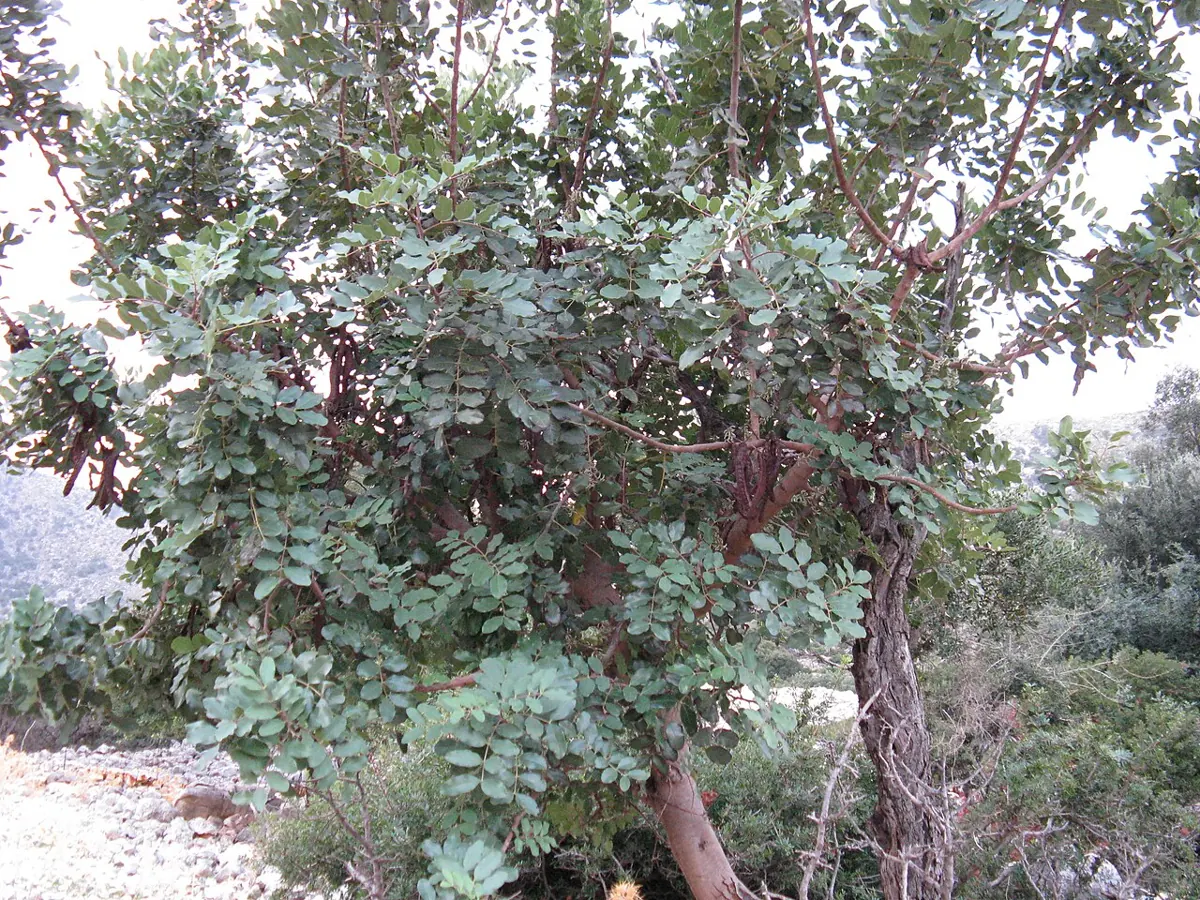
An evergreen tree with leaves of thick, round leaflets and long brown pods.
- LeafBroad and flat
- LeafLeaflets in two rows
- ShapeRound
- ShapeOval
- EdgeSmooth
- On the twigOne at a time, staggered
- In winterYes, always green
- BarkFurrowed
- FruitPod
The leaf
The leaf is made up of two to five pairs of rounded or oval leaflets, thick, glossy on top and smooth-edged. There is no leaflet at the tip. It is dark green all year round.
The bark
The bark is grey-brown, smooth on young branches and rough and cracked on old trunks, which are usually thick and twisted.
The fruit
The fruit is the carob, a long, flat, slightly curved pod ten to twenty centimetres long. It is green in summer and dark brown and hard when ripe; the sweet pulp surrounds very hard seeds.
The flower
It flowers in autumn. The flowers are small, reddish or greenish, without petals, and grow in short clusters straight from the old branches and the trunk.
- Jan
- Feb
- Mar
- Apr
- May
- Jun
- Jul
- Aug
- Sep
- Oct
- Nov
- Dec
Habit
A tree with a short, thick trunk and a broad, rounded, very dense crown that casts deep shade.
Where it grows
It needs mild winters. In Catalonia it has been grown since ancient times along the coast and in the southern lowlands, such as the Camp de Tarragona, the Baix Ebre and the Montsià, and also in the Garraf and the Baix Penedès.
What it can be mistaken for
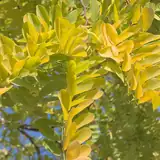
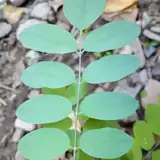
The honey locust also bears long pods, but it loses its leaves in winter, has very small leaflets and usually has thorns. The black locust has thinner leaflets, with one at the tip, and thorns on its branches.
A story
The word carat comes from the Greek keration, the name for the carob seed, which was used to weigh precious stones. Carob pods have been used as animal feed and, in times of famine, as food for people too.
Find out more
- Tree: S. Rae, CC BY 2.0
- Leaf: Agnieszka Kwiecień, Nova, CC BY-SA 4.0
- Bark: Agnieszka Kwiecień, Nova, CC BY-SA 4.0
- Fruit: Nevit Dilmen, CC BY-SA 3.0