Trees · Arecaceae
Canary Island date palm
Phoenix canariensis
Spanish Palmera canariaCatalan Palmera canàriaIntroduced10–20 mEvergreen
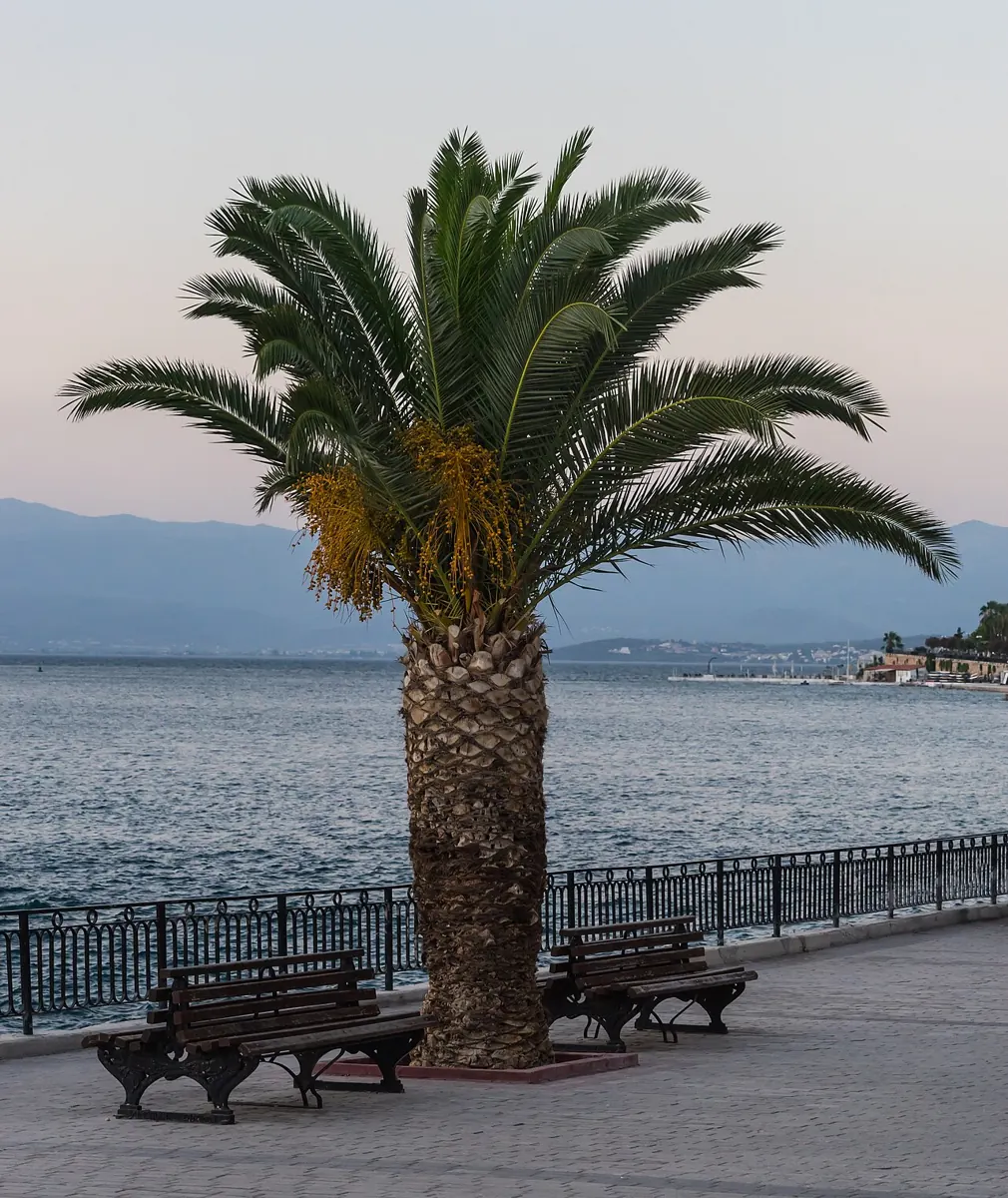
A palm with a very thick trunk and a huge, dense crown of bright green feather leaves.
- LeafPalm fronds
- In winterYes, always green
- BarkRinged or covered in old leaf bases
- FruitBunches of dates
The leaf
Arching, feather-shaped leaves 4 to 6 m long, a bright, glossy green, with a great many narrow leaflets. Those at the base of the stalk are long, hard spines.
The bark
A single, very thick trunk, 60 cm to 1 m or more across, covered in diamond-shaped leaf scars, like a pineapple.
The fruit
Small dates, 2 to 3 cm, oval and orange, in large hanging bunches. They have little flesh and are not usually eaten.
The flower
Small cream flowers in branched clusters among the leaves. There are male palms and female palms.
- Jan
- Feb
- Mar
- Apr
- May
- Jun
- Jul
- Aug
- Sep
- Oct
- Nov
- Dec
Habit
A palm 10 to 20 m tall, with a single thick, straight trunk and a very broad, round crown of up to a hundred leaves.
Where it grows
It is native only to the Canary Islands. In Catalonia it is the most widely planted palm in squares, promenades, farmhouse gardens and summer villas.
What it can be mistaken for
The date palm has a much slimmer trunk, greyish leaves and a sparser crown, often with suckers at the base. The dwarf fan palm is low and has fan-shaped leaves.
A story
Since the 1990s the red palm weevil, a beetle from Asia whose larvae eat the heart of the palm from the inside, has killed thousands of Canary Island palms along the Mediterranean coast. An infested palm drops its central leaves and the crown splays open like a broken umbrella.
Find out more
- Tree: Jebulon, CC0
- Leaf: Flocci Nivis, CC BY 4.0
- Bark: Krzysztof Ziarnek, Kenraiz, CC BY-SA 4.0
- Fruit: Quartl, CC BY-SA 3.0