Trees · Fagaceae
Cork oak
Quercus suber
Spanish AlcornoqueCatalan SureraNative10–20 mEvergreen
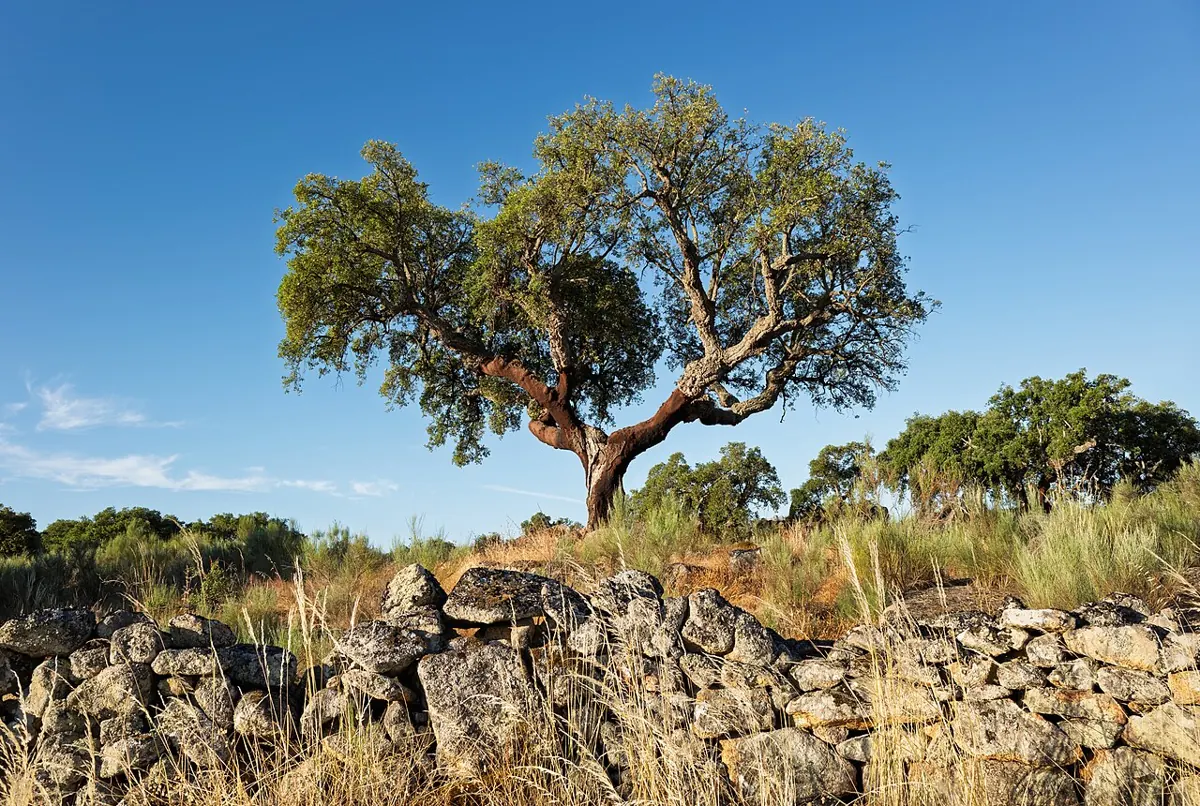
Like the holm oak, but with a trunk wrapped in thick cork, or stripped and reddish.
- LeafBroad and flat
- LeafYes, a single blade
- ShapeOval
- EdgeToothed
- EdgeSmooth
- On the twigOne at a time, staggered
- In winterYes, always green
- BarkCorky
- FruitAcorn
The leaf
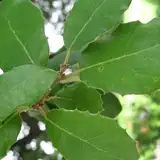
Evergreen leaves 3 to 7 cm long, oval, with small teeth on the edge. They are dark green above and grey and felted beneath, like those of the holm oak but a little softer and with a wavy midrib.
The bark
Unmistakable: a thick layer of cork, grey, soft and deeply fissured, that gives when you press it. Freshly stripped, the trunk is smooth and orange-red, darkening later.
The fruit
Acorns 2 to 4 cm long, with a cup of long scales that bristle slightly at the rim. Some ripen the same autumn and others the following year.
The flower
Hanging yellowish catkins in spring, like those of the holm oak. The female flowers are tiny.
- Jan
- Feb
- Mar
- Apr
- May
- Jun
- Jul
- Aug
- Sep
- Oct
- Nov
- Dec
Habit
A tree 10 to 20 m tall, with a thick trunk and a broad, rounded crown, a little paler than the holm oak's.
Where it grows
It needs lime-free soils over granite or slate, and some moisture. In Catalonia it forms woods in the Gavarres, the Guilleries, Montnegre, the lower Montseny and the Albera, mostly in the province of Girona. It does not grow on the limestone soils of the Penedès.
What it can be mistaken for
The holm oak has similar leaves, but its bark is hard and dark, never corky. The kermes oak is a shrub with prickly leaves that are green on both sides.
A story
The cork is stripped by hand every nine years or more without harming the tree. Thanks to it, Sant Feliu de Guíxols and Palafrugell in Girona became great cork-stopper towns, and the cork oak woods supply the corks for the cava of the Penedès.
Find out more
- Tree: Jules Verne Times Two, CC BY-SA 4.0
- Leaf: Arielinson, CC BY-SA 4.0
- Bark: sailko, CC BY-SA 3.0
- Fruit: Xemenendura, CC BY-SA 3.0