Trees · Arecaceae
Date palm
Phoenix dactylifera
Spanish Palmera datileraCatalan Palmera datileraIntroduced15–25 mEvergreen
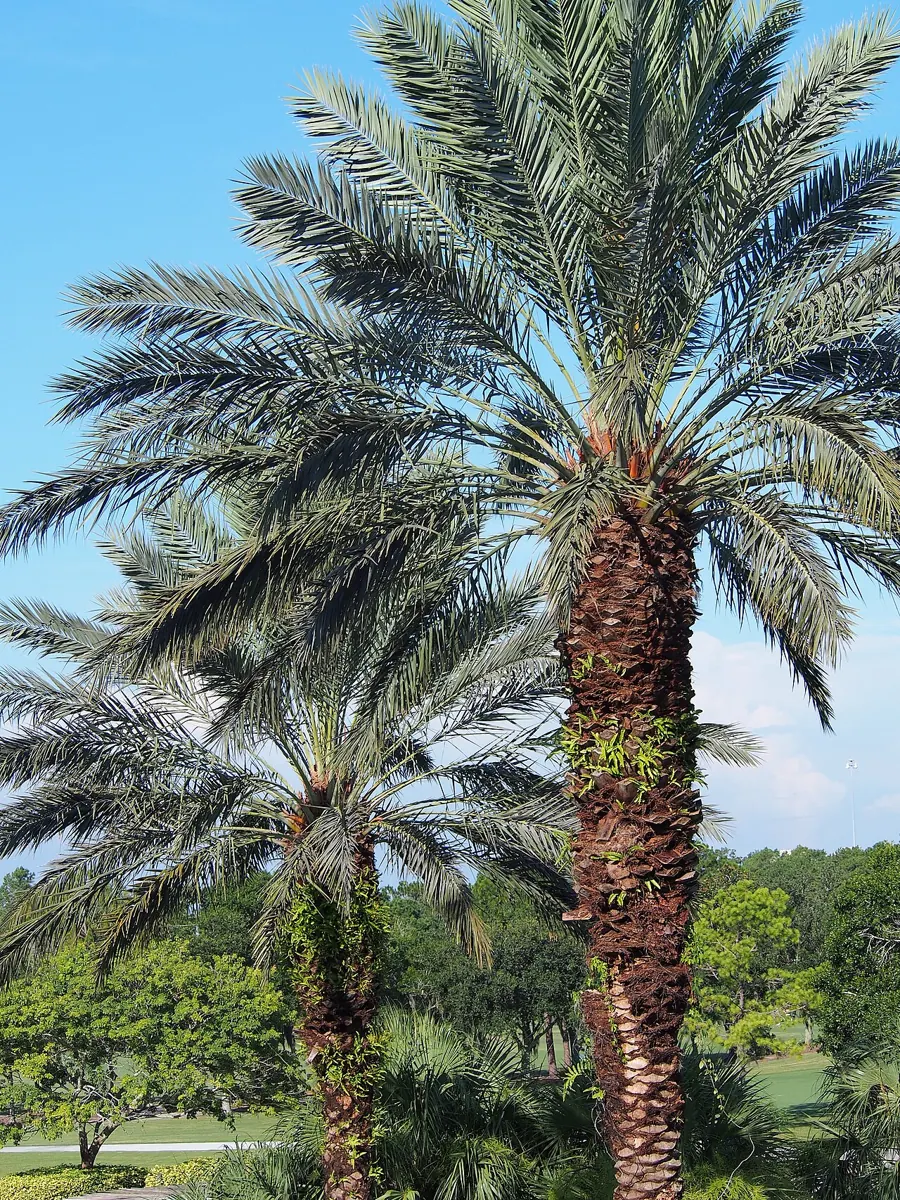
A tall, slender palm with a thin trunk and grey-blue feather leaves, often with suckers at the base.
- LeafPalm fronds
- In winterYes, always green
- BarkRinged or covered in old leaf bases
- FruitBunches of dates
The leaf
Feather-shaped leaves 3 to 6 m long, greyish or bluish green, with stiff, narrow leaflets. Those at the base of the stalk turn into long, hard spines.
The bark
The trunk is slim, 30 to 50 cm across, and covered by the bases of cut leaves, which form a stepped pattern.
The fruit
The dates are elongated, 3 to 7 cm, and hang in large bunches; they turn from yellow or orange to brown as they ripen. Only female trees bear them.
The flower
The flowers are small and cream-coloured, in large branched clusters among the leaves. Male and female flowers grow on separate palms.
- Jan
- Feb
- Mar
- Apr
- May
- Jun
- Jul
- Aug
- Sep
- Oct
- Nov
- Dec
Habit
A palm 15 to 25 m tall, with a slender trunk and a fairly open crown. It often produces suckers at the base, which if left form clumps of several trunks.
Where it grows
It comes from the oases of North Africa and the Middle East. In Catalonia it is planted along seafronts, in squares and in gardens, especially near the coast.
What it can be mistaken for
The Canary Island date palm has a much thicker trunk, a very dense crown and bright green, not greyish, leaves. The dwarf fan palm is low and has fan-shaped leaves.
A story
The Palm Grove of Elche, with tens of thousands of date palms, is a World Heritage Site. It supplies the white palm fronds blessed on Palm Sunday, bleached by tying the leaves up so the sun cannot reach them.
Find out more
- Tree: Agnieszka Kwiecień, Nova, CC BY-SA 4.0
- Leaf: Justwiki, CC0
- Bark: Ahmed1251985, CC BY-SA 4.0
- Fruit: Noblevmy, CC BY 3.0