Trees · Fagaceae
Kermes oak
Quercus coccifera
Spanish CoscojaCatalan GarricNative1–3 mEvergreen
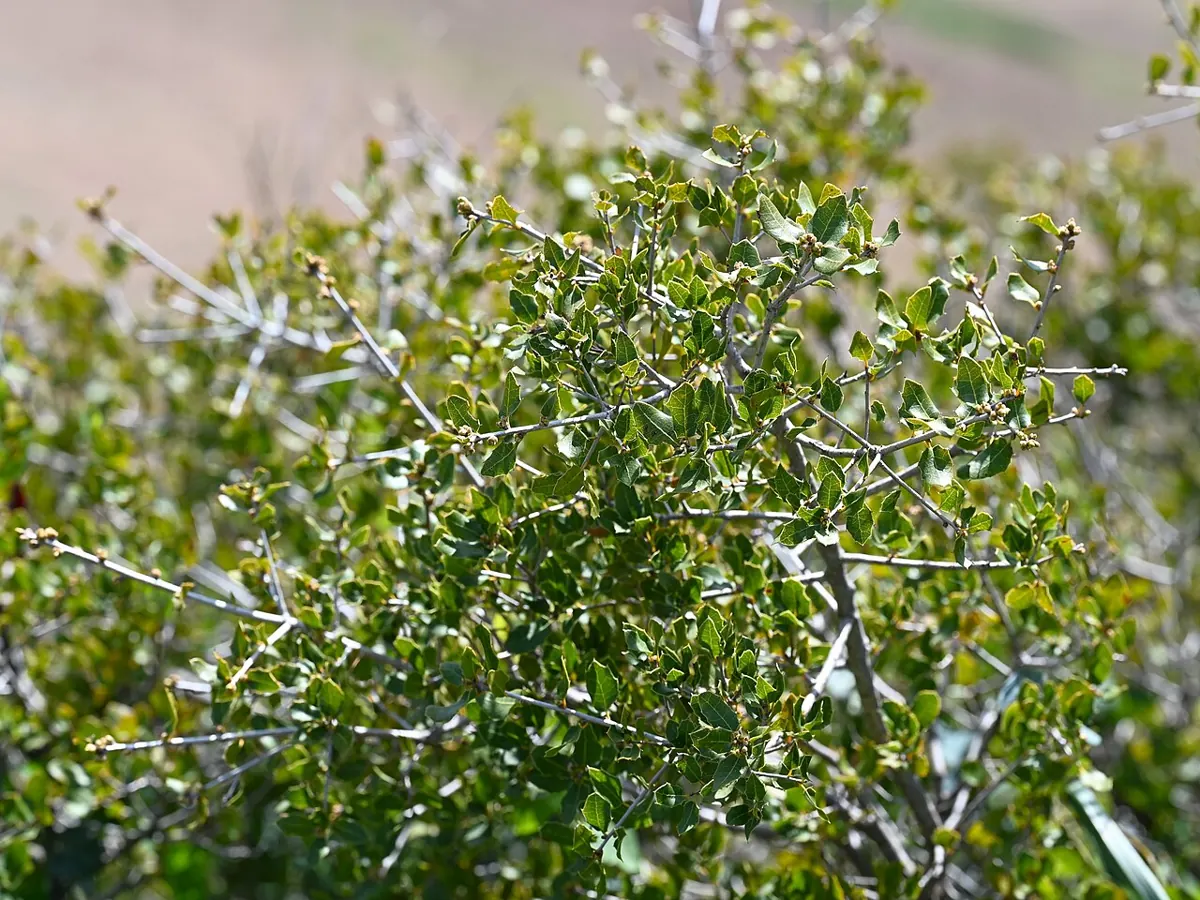
A dense thicket of small, tough leaves, shiny green on both sides, with prickly edges.
- LeafBroad and flat
- LeafYes, a single blade
- ShapeOval
- EdgePrickly
- EdgeToothed
- On the twigOne at a time, staggered
- In winterYes, always green
- BarkSmooth
- FruitAcorn
The leaf
Small leaves, 1.5 to 4 cm, tough, wavy and edged with spiny teeth. They are shiny green on both sides, without the grey down of the holm oak.
The bark
Smooth and grey on the branches; only large, old plants have a slightly fissured trunk.
The fruit
Acorns 1.5 to 3 cm long, in a thick cup covered in stiff, pointed scales that prick. They ripen in their second year.
The flower
Hanging yellowish catkins in spring; the female flowers are tiny.
- Jan
- Feb
- Mar
- Apr
- May
- Jun
- Jul
- Aug
- Sep
- Oct
- Nov
- Dec
Habit
Almost always a dense, impenetrable shrub 1 to 3 m tall that resprouts vigorously after fire. Only very rarely does it become a small tree.
Where it grows
It covers the dry, sunny, stony slopes of coastal and southern Catalonia, especially on limestone. It is very abundant in the Garraf and in the garrigue and dry pine woods of the Penedès.
What it can be mistaken for
The holm oak has leaves that are grey and felted beneath and an acorn cup with flat scales. The holly has much larger leaves and red berries, and grows in damp mountains. The prickly juniper also pricks, but it has needles.
A story
The word garrigue comes from garric, the Catalan name for the kermes oak. It is home to the kermes scale insect, which was once the source of a highly prized red dye called grain.
Find out more
- Tree: Krzysztof Ziarnek, Kenraiz, CC BY-SA 4.0
- Leaf: Júlio Reis (Tintazul), CC BY-SA 2.5
- Bark: Marija Gajić, CC BY-SA 4.0
- Fruit: Hans Hillewaert, CC BY-SA 3.0