Trees · Pinaceae
Maritime pine
Pinus pinaster
Spanish Pino rodenoCatalan PinastreNative20–30 mEvergreen
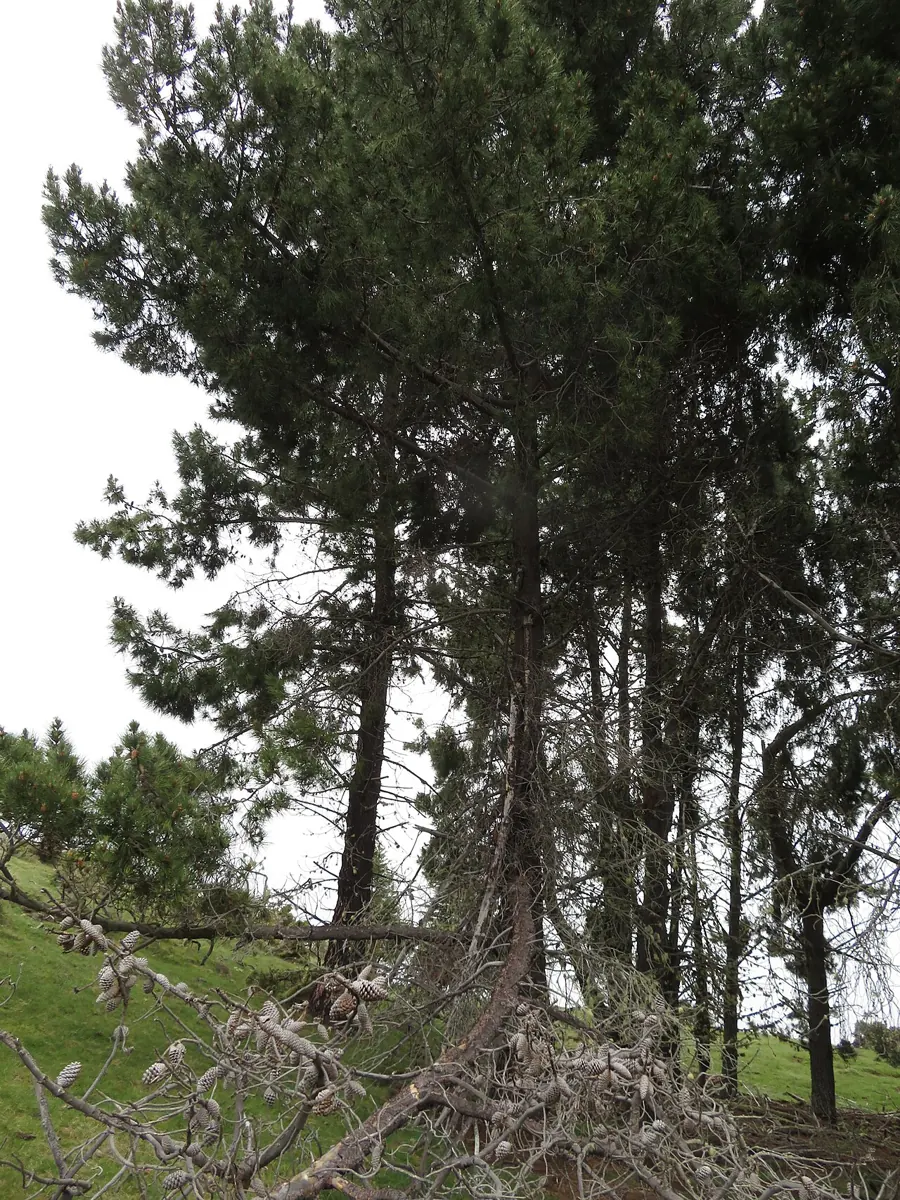
A pine with very long, thick, prickly needles and dark, deeply fissured bark.
- LeafNeedles
- NeedlesIn pairs
- In winterYes, always green
- BarkFurrowed
- BarkFlaking in plates
- FruitCone
The leaf
Needles in pairs, the longest and thickest of any of our pines: 15 to 25 cm, stiff and with a sharp tip. They are a dark, slightly greyish green.
The bark
Very thick, split by deep fissures into large plates. The plates are dark brown on the outside and reddish where they flake.
The fruit
Large, conical, elongated cones, 10 to 20 cm, glossy brown, with each scale ending in a point. They sit almost flat against the branch, often in groups.
The flower
The male cones are yellow and bunched at the base of the new shoots. The female ones are reddish and grow at the tips, usually several together.
- Jan
- Feb
- Mar
- Apr
- May
- Jun
- Jul
- Aug
- Sep
- Oct
- Nov
- Dec
Habit
A tall tree with a straight trunk, 20 to 30 m, conical when young and later irregular, with dead lower branches.
Where it grows
In Catalonia it grows on acid soils over granite or slate, away from limestone: Montnegre, the lower Montseny, the Gavarres, the Guilleries. It is far more common in the west of the Iberian Peninsula, especially in Galicia, the Sistema Central and the pine country of Castile.
What it can be mistaken for
Its long cones and the lack of an umbrella crown separate it from the stone pine. Its needles separate it from the Aleppo pine: in the maritime pine they are much longer, thicker and darker. The Monterey pine carries its needles in threes.
A story
This was the great resin pine of Spain: in Castile its trunks are still scored to collect resin, which is distilled into turpentine and rosin. It was also widely planted to hold coastal dunes in place.
Find out more
- Tree: Forest and Kim Starr, CC BY 2.0
- Leaf: Forest and Kim Starr, CC BY 2.0
- Bark: Luis Fernández García, CC BY-SA 2.5 es
- Fruit: D. Hristov, CC BY-SA 3.0