Trees · Pinaceae
Aleppo pine
Pinus halepensis
Spanish Pino carrascoCatalan Pi blancNative8–20 mEvergreen
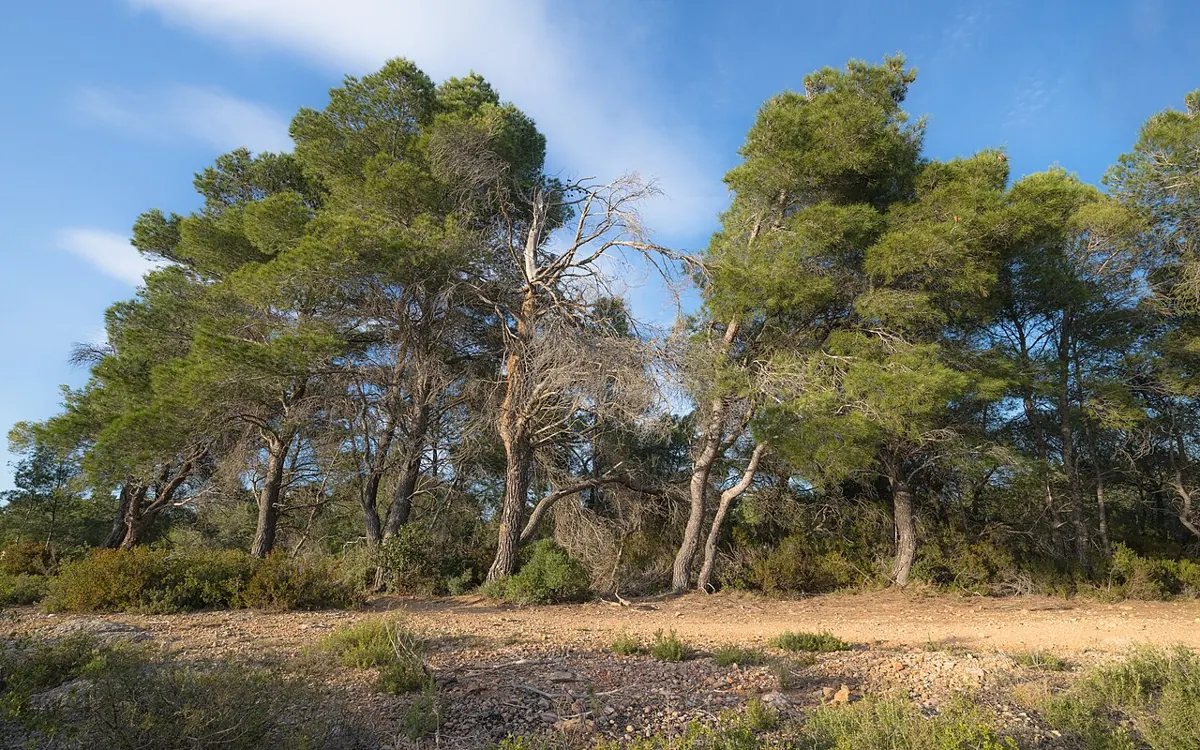
A pine with an open crown, fine pale green needles and a grey trunk, often leaning or twisted.
- LeafNeedles
- NeedlesIn pairs
- In winterYes, always green
- BarkFurrowed
- BarkSmooth
- FruitCone
The leaf
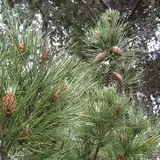
Needles in pairs, very thin and flexible, 6 to 10 cm long and a pale yellowish green. They gather in tufts towards the ends of the branches, so the crown stays thin and lets plenty of light through.
The bark
Smooth and silvery grey when young, and it stays that way on the branches. On old trunks it darkens and cracks into long plates, with reddish bark showing at the bottom of the fissures.
The fruit
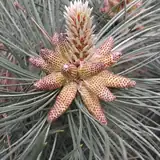
Conical cones 5 to 12 cm long, cinnamon brown, on a thick stalk that bends backwards. Many stay closed on the tree for years and only open in the heat of a fire.
The flower
The male flowers are yellow clusters at the base of the new shoots, which release clouds of pollen in spring. The female ones are small reddish conelets at the tips of the branches.
- Jan
- Feb
- Mar
- Apr
- May
- Jun
- Jul
- Aug
- Sep
- Oct
- Nov
- Dec
Habit
A tree 8 to 20 m tall, its trunk often leaning or twisted and its crown irregular and open. Young trees are conical; with age the crown flattens and becomes uneven.
Where it grows
The most common pine in lowland, Mediterranean Catalonia, especially on dry limestone soils from the coast up to about 800 m. In the Penedès it makes up most of the woodland, often with holm oak and kermes oak beneath, and it is widely planted in parks and housing estates.
What it can be mistaken for
The stone pine has longer, stiffer, darker needles and an umbrella-shaped crown. The maritime pine has very thick, long needles and dark, deeply fissured bark. The Aleppo pine gives itself away with its fine pale needles and its cones on bent-back stalks.
A story
This pine is adapted to fire: its closed cones keep seeds that are released after a blaze, which is why burnt pine woods usually come back thick with young pines. It used to be tapped for resin, and its wood was used for firewood and crates.
Find out more
- Tree: Christian Ferrer, CC BY-SA 3.0
- Leaf: IM027, CC BY-SA 4.0
- Bark: Philmarin, CC BY-SA 4.0
- Fruit: Krzysztof Ziarnek, Kenraiz, CC BY-SA 4.0