Trees · Pinaceae
Monterey pine
Pinus radiata
Spanish Pino de MonterreyCatalan Pi de MonterreyIntroduced15–30 mEvergreen
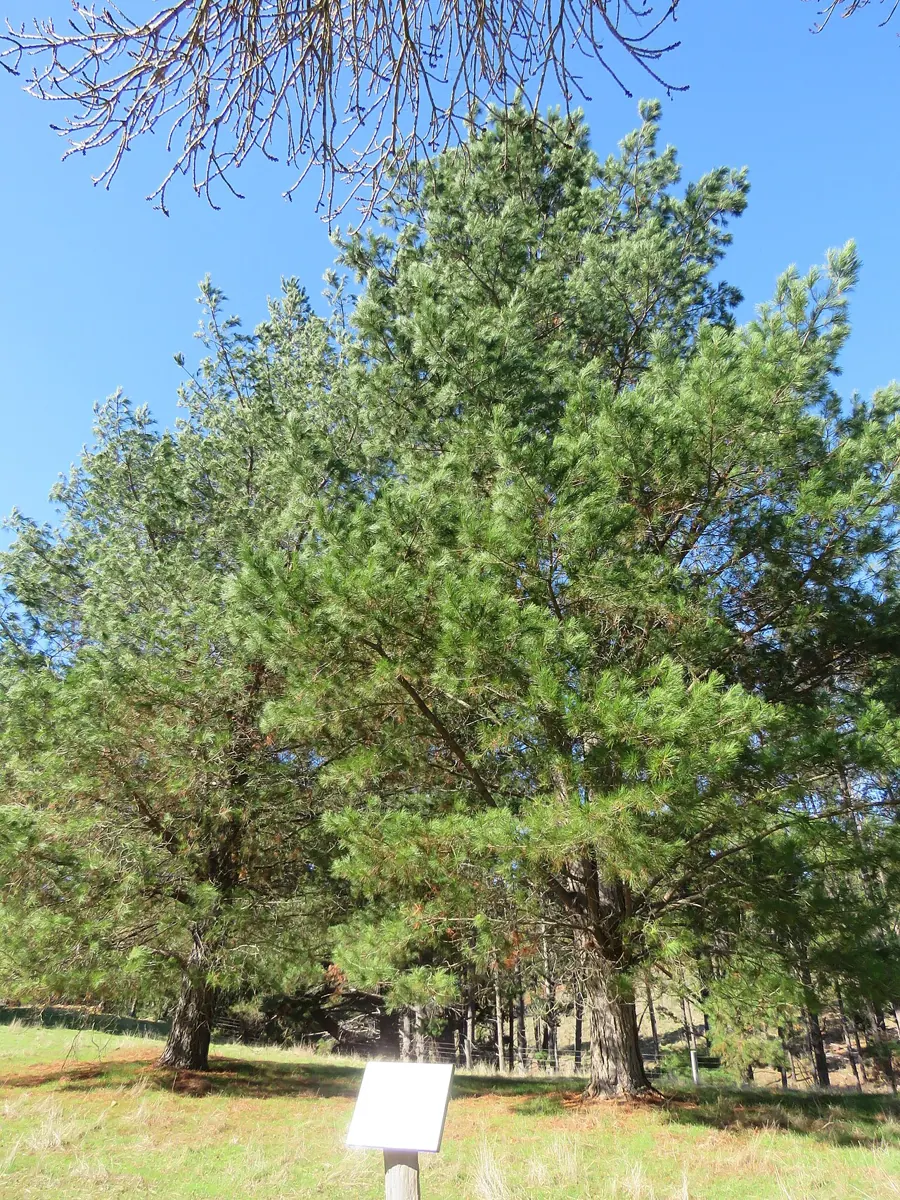
A fast-growing pine with bright green needles in threes and lopsided cones stuck to the branches.
- LeafNeedles
- NeedlesIn threes
- In winterYes, always green
- BarkFurrowed
- FruitCone
The leaf
Needles in threes, 10 to 15 cm long, thin, flexible and a bright, glossy green. They give the crown a dense, lush look.
The bark
Dark grey or blackish brown, thick, split by deep fissures into long plates.
The fruit
Cones 7 to 15 cm long, oval and very lopsided, with the scales on the outer side swollen. They stay closed on the tree for many years, in clusters around the trunk and branches.
The flower
Yellow male cones at the base of the shoots and small reddish female conelets. It flowers in late winter.
- Jan
- Feb
- Mar
- Apr
- May
- Jun
- Jul
- Aug
- Sep
- Oct
- Nov
- Dec
Habit
A tree 15 to 30 m tall, with a straight trunk and a conical crown when young, later rounded or irregular. It grows very fast.
Where it grows
It comes from California. In Spain it is planted mainly in the Atlantic north, in the Basque Country, Cantabria and Galicia, for timber. In Catalonia it is uncommon.
What it can be mistaken for
Our native pines, such as the maritime pine or the Aleppo pine, carry their needles in pairs. Needles in threes and lopsided cones clamped to the branch belong to the Monterey pine.
A story
In the wild only a few natural stands survive, on the coast of California and on two Mexican islands, yet it is one of the most widely planted pines in the world, especially in New Zealand and Chile.
Find out more
- Tree: Calistemon, CC BY-SA 4.0
- Leaf: Forest and Kim Starr, CC BY 3.0 us
- Bark: Bjankuloski06, CC BY 4.0
- Fruit: minicooper93402, CC BY 2.0