Trees · Pinaceae
Stone pine
Pinus pinea
Spanish Pino piñoneroCatalan Pi pinyerNative12–25 mEvergreen
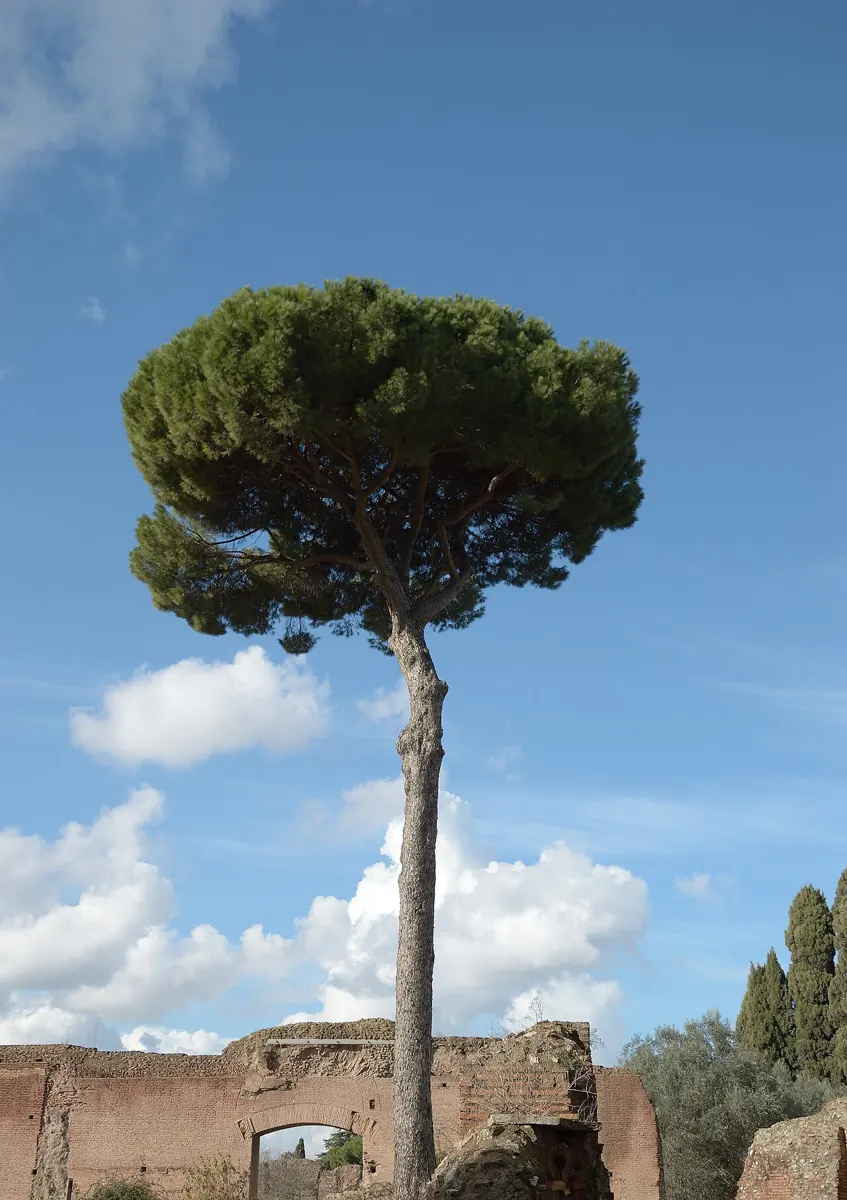
A pine with a broad, flat, umbrella-shaped crown and fat, round cones.
- LeafNeedles
- NeedlesIn pairs
- In winterYes, always green
- BarkFlaking in plates
- BarkFurrowed
- FruitCone
The leaf
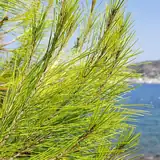
Needles in pairs, 10 to 20 cm long, stiff and a slightly greyish green. Young trees also have short, single, bluish needles, quite unlike those of the adult.
The bark
Thick and reddish brown, broken into large, long plates separated by deep, darker fissures. When the plates fall they leave orange patches.
The fruit
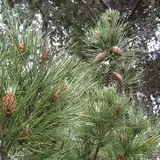
Large, heavy, almost spherical cones, 8 to 15 cm, glossy chestnut brown. They take three years to ripen and hold the pine nuts: a hard shell around an edible seed.
The flower
The male cones are yellowish and grouped at the base of the year's shoots; the small, greenish female ones grow at the tips. It flowers in spring, a little later than the Aleppo pine.
- Jan
- Feb
- Mar
- Apr
- May
- Jun
- Jul
- Aug
- Sep
- Oct
- Nov
- Dec
Habit
A mature tree has a straight trunk that splits higher up into several thick limbs, topped by a broad, flat, dense crown like an umbrella. It is usually 12 to 25 m tall.
Where it grows
In Catalonia it belongs to loose, sandy soils near the coast and to the milder inland plains, such as the Maresme, the Vallès or the Empordà. It is often planted beside farmhouses and in parks and promenades for its shade.
What it can be mistaken for
The Aleppo pine has fine, pale needles and elongated cones; the maritime pine has long, conical cones and even thicker needles. The umbrella crown and the fat, round cone set the stone pine apart.
A story
Pine nuts have been gathered for food since ancient times and go into many sweets, such as the panellets eaten in Catalonia on All Saints' Day. To get them out, the cones are left in the sun or heated until they open.
Find out more
- Tree: Livioandronico2013, CC BY-SA 4.0
- Leaf: Emőke Dénes, CC BY-SA 4.0
- Bark: Agnieszka Kwiecień, Nova, CC BY-SA 4.0
- Fruit: Wouter Hagens, CC BY-SA 4.0