Trees · Pinaceae
Salzmann pine
Pinus nigra subsp. salzmannii
Spanish Pino laricioCatalan PinassaNative20–35 mEvergreen
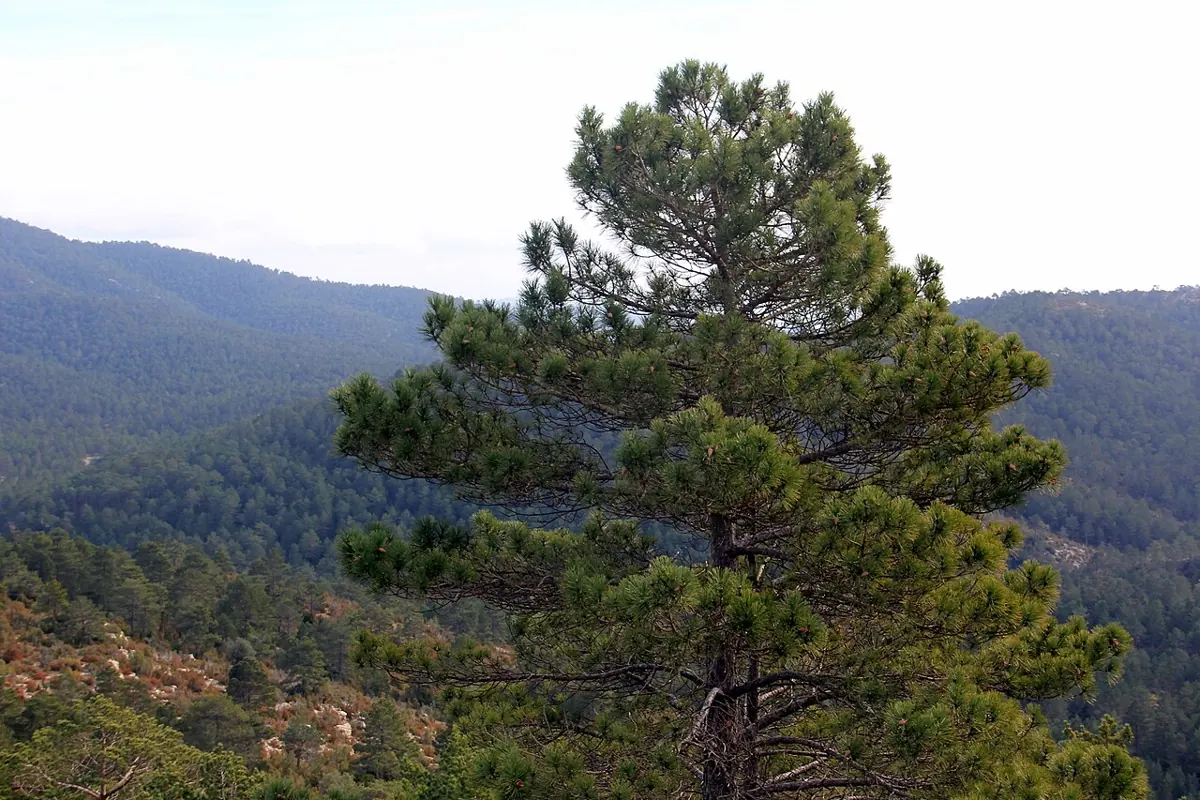
A pine with a grey trunk and a dark crown, with long, stiff, very dark green needles.
- LeafNeedles
- NeedlesIn pairs
- In winterYes, always green
- BarkFurrowed
- BarkFlaking in plates
- FruitCone
The leaf
Needles in pairs, 8 to 16 cm, stiff and straight, a dark, almost blackish green. They give the crown a more sombre tone than other pines.
The bark
Grey or dark grey, split into long plates by deep fissures. On old trees the plates turn pale, almost silvery.
The fruit
Cones 4 to 8 cm long, oval and nearly symmetrical, glossy yellowish brown. They have almost no stalk and open in their second winter.
The flower
Yellow male cones grouped at the base of the shoots and small reddish female conelets at the tips. It flowers in late spring.
- Jan
- Feb
- Mar
- Apr
- May
- Jun
- Jul
- Aug
- Sep
- Oct
- Nov
- Dec
Habit
A tree 20 to 35 m tall, with a straight trunk and a conical crown when young. Old trees have a broad, flat crown, like a table top.
Where it grows
In Catalonia it forms forests in the centre of the country and the Pre-Pyrenees, between about 500 and 1,400 m: the Solsonès, Bages, Berguedà and Lluçanès. It prefers limestone and a climate with cold winters.
What it can be mistaken for
The Scots pine has an orange upper trunk and shorter, bluish needles. The Aleppo pine has fine, pale needles. Long, very dark needles and a grey trunk mark the Salzmann pine.
A story
Unlike the Aleppo pine, it keeps no closed cones in reserve for after a fire, and it struggles to come back after a big blaze. The great fires of 1994 and 1998 in central Catalonia wiped out thousands of hectares of these pine woods, known in Catalan as pinassa, and in many places they have not returned.
Find out more
- Tree: Joan Simon, CC BY-SA 2.0
- Leaf: Fritz Geller-Grimm, CC BY-SA 2.5
- Bark: Plant Image Library, CC BY-SA 2.0
- Fruit: Zeynel Cebeci, CC BY-SA 4.0