Trees · Pinaceae
Scots pine
Pinus sylvestris
Spanish Pino silvestreCatalan Pi roigNative20–35 mEvergreen
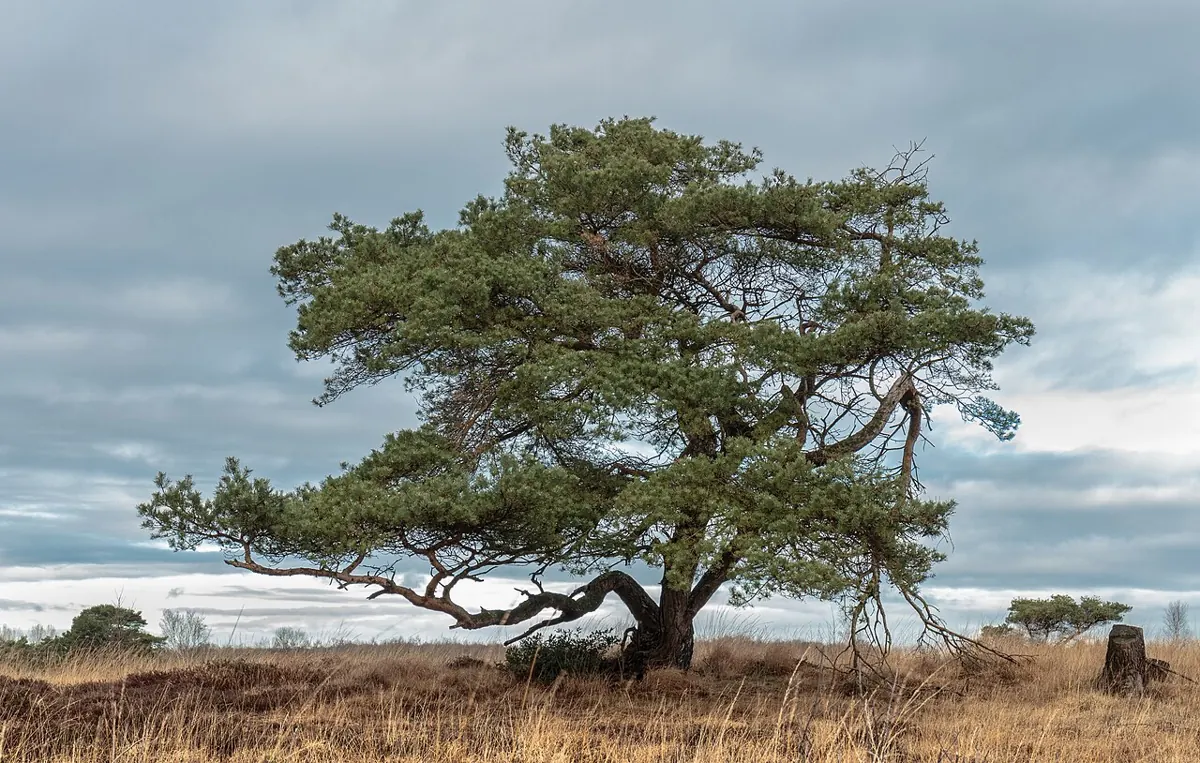
A mountain pine with an orange upper trunk and short, bluish needles.
- LeafNeedles
- NeedlesIn pairs
- In winterYes, always green
- BarkFlaking in plates
- BarkFurrowed
- FruitCone
The leaf
Needles in pairs, short, 3 to 7 cm, slightly twisted and a bluish or greyish green. They are stiff but barely prickle.
The bark
This is its best feature: on the upper trunk and the thicker branches it is thin, orange or reddish, and peels in papery flakes. At the base of old trunks it is grey-brown, thick and fissured.
The fruit
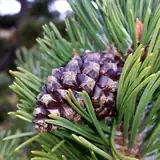
Small cones, 3 to 7 cm, oval and pointed, grey-brown when ripe. They hang on a short stalk and open at the end of winter.
The flower
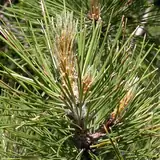
The male cones are yellow and crowded at the base of the year's shoots. The female conelets are reddish or purple and grow at the shoot tips.
- Jan
- Feb
- Mar
- Apr
- May
- Jun
- Jul
- Aug
- Sep
- Oct
- Nov
- Dec
Habit
A tall, slender tree, 20 to 35 m, with a straight trunk and the crown high up. Young trees are conical; with age the crown flattens and becomes irregular.
Where it grows
In Catalonia it is the pine of the middle mountains: it forms large forests in the Pre-Pyrenees and the Pyrenees, roughly between 800 and 2,000 m, and there are also pine woods in the inland ranges. It does not grow on the plain of the Penedès.
What it can be mistaken for
The mountain pine lives higher up and has dark bark with no orange, and greener needles. The Salzmann pine has longer, darker needles and a grey trunk. The orange upper trunk and short bluish needles give the Scots pine away.
A story
Its straight, strong timber was widely used for beams and building. In the Pyrenees the logs were floated down the rivers lashed into rafts, the rais, steered by the raftsmen, the raiers, along the Segre and the Noguera Pallaresa.
Find out more
- Tree: Agnes Monkelbaan, CC BY-SA 4.0
- Leaf: George Chernilevsky, CC BY 4.0
- Bark: Akkbula, CC BY-SA 4.0
- Fruit: Autor desconocido, CC BY-SA 2.1 es