Trees · Magnoliaceae
Southern magnolia
Magnolia grandiflora
Spanish MagnolioCatalan MagnòliaIntroduced8–20 mEvergreen
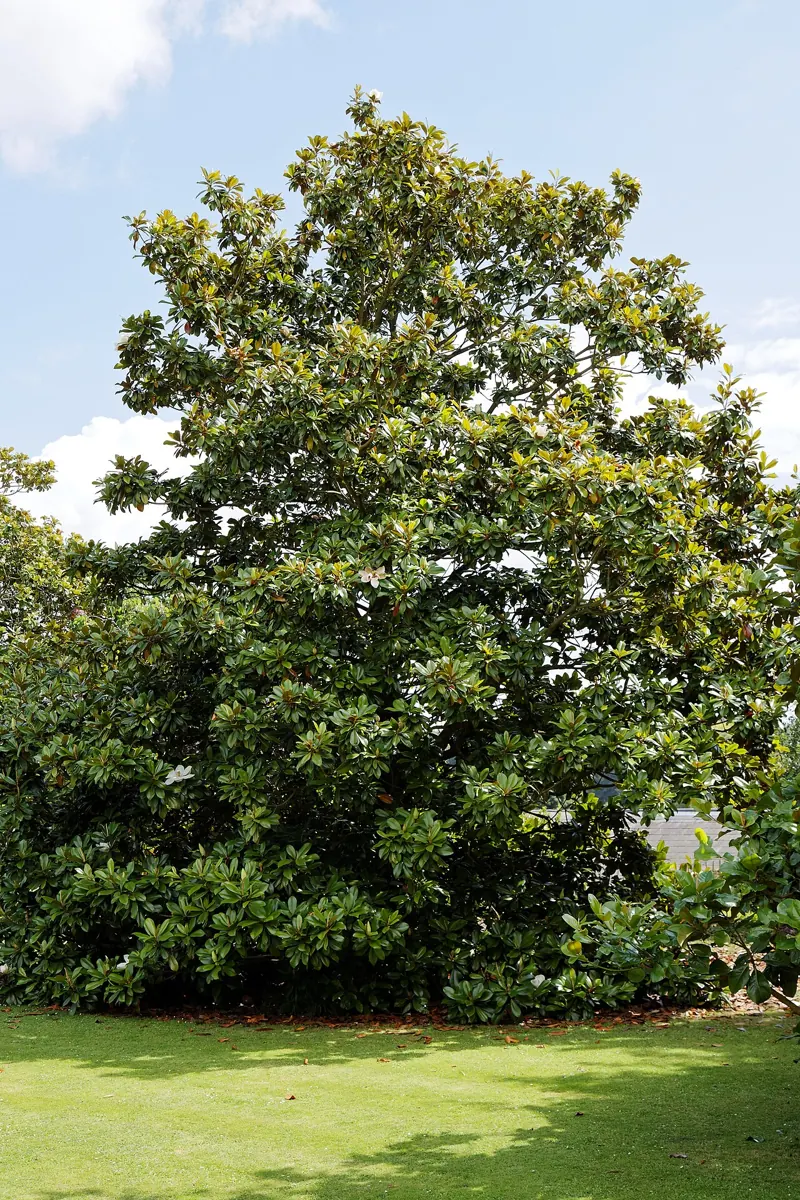
Large, thick, glossy leaves with rust-coloured undersides, and huge white flowers in summer.
- LeafBroad and flat
- LeafYes, a single blade
- ShapeOval
- EdgeSmooth
- On the twigOne at a time, staggered
- In winterYes, always green
- BarkSmooth
- FruitCapsule that splits open
The leaf
A simple leaf, 12 to 20 cm, oval, smooth-edged and leathery. On top it is dark green and very glossy, and underneath it usually has a reddish-brown fuzz.
The bark
Grey and smooth, with a few fine scales on old trunks.
The fruit
A sort of hairy, oval cone that opens in autumn and lets bright red seeds dangle out.
The flower
Huge white flowers, up to 25 cm across, with thick petals and a strong scent. It flowers from May to July, a few at a time.
- Jan
- Feb
- Mar
- Apr
- May
- Jun
- Jul
- Aug
- Sep
- Oct
- Nov
- Dec
Habit
A tree with a dense, dark crown, oval or pyramid-shaped, branching from low down.
Where it grows
It is planted in gardens, squares and courtyards throughout Catalonia. It comes from the south-eastern United States and appreciates watering in summer.
What it can be mistaken for
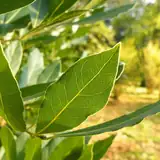
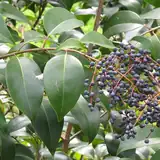
The bay laurel has smaller, aromatic leaves with wavy edges and no fuzz underneath. The glossy privet has much smaller, opposite leaves.
A story
Magnolias belong to a very ancient family of flowering plants, older than bees. Their flowers are pollinated mainly by beetles, which is why the petals are so tough.
Find out more
- Tree: Acabashi, CC BY-SA 4.0
- Leaf: Famartin, CC BY-SA 4.0
- Bark: KENPEI, CC BY-SA 3.0
- Fruit: Meneerke bloem, CC BY-SA 4.0
- Flower: Ianaré Sévi, CC BY-SA 3.0