Trees · Oleaceae
Glossy privet
Ligustrum lucidum
Spanish AligustreCatalan LligustreIntroduced6–12 mEvergreen
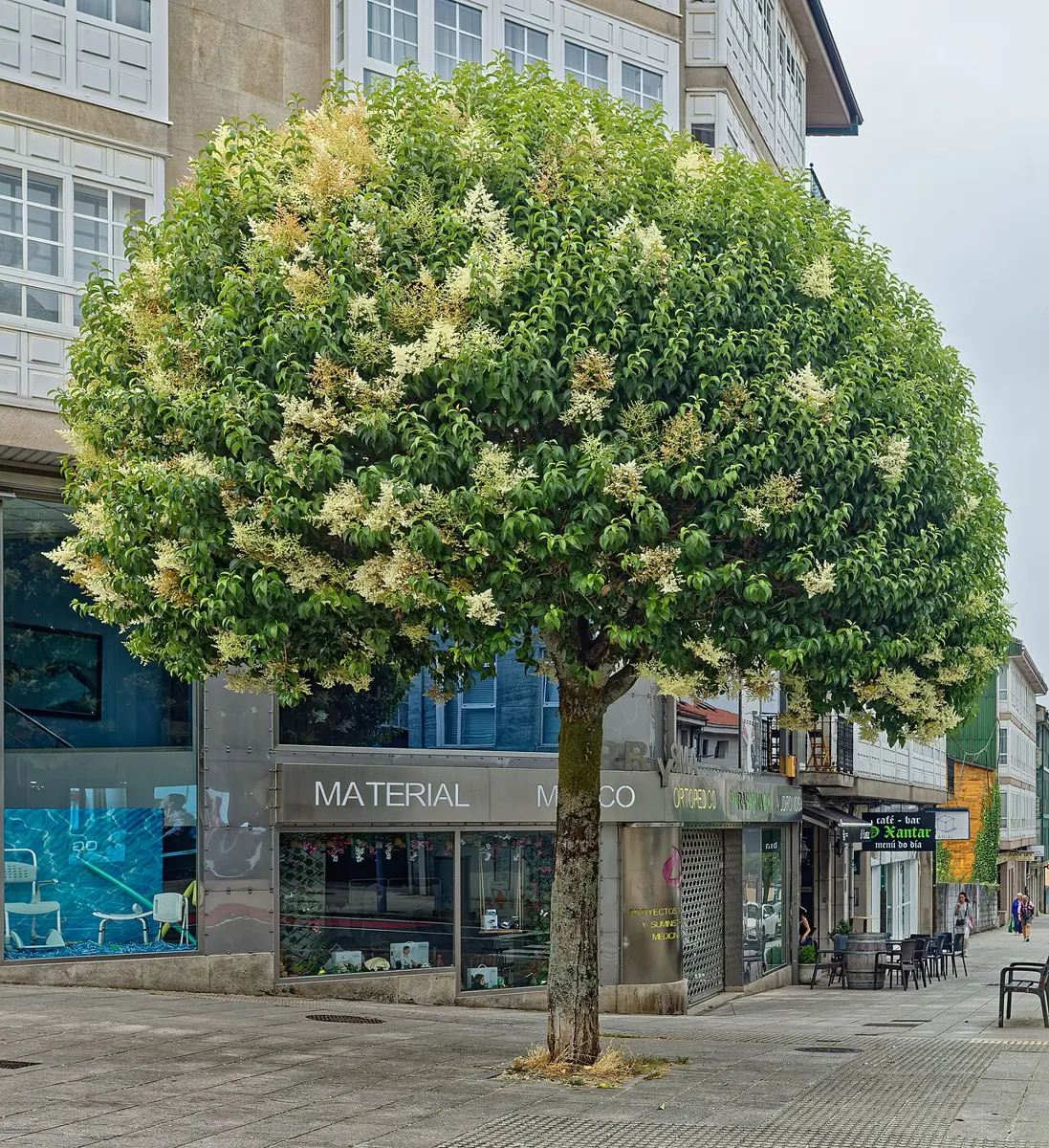
An evergreen street tree with glossy, opposite leaves and clusters of little blue-black berries in winter.
- LeafBroad and flat
- LeafYes, a single blade
- ShapeOval
- EdgeSmooth
- On the twigIn pairs, facing each other
- In winterYes, always green
- BarkSmooth
- FruitFleshy
The leaf
A simple leaf, oval and pointed, 8 to 12 cm, with a smooth edge. It is hairless, thick and glossy on top. The leaves grow opposite, in pairs.
The bark
Pale grey and smooth, with small raised dots. It doesn't crack, even on old trunks.
The fruit
Small, oval, blue-black berries with a powdery bloom, in clusters. They ripen in autumn and stay on the tree through the winter. They are not edible.
The flower
Tiny white flowers in large, pyramid-shaped clusters, with a strong, rather sickly-sweet smell. It flowers in early summer.
- Jan
- Feb
- Mar
- Apr
- May
- Jun
- Jul
- Aug
- Sep
- Oct
- Nov
- Dec
Habit
A small or medium-sized tree with a dense, rounded crown. In town it is usually clipped into a ball.
Where it grows
It is one of the most planted trees in the streets of Barcelona and other Catalan towns. It comes from China, and birds spread its seeds, so it pops up in gardens and on building plots.
What it can be mistaken for
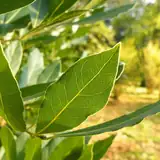
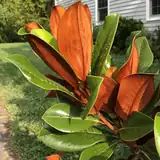
The bay laurel has alternate leaves that are aromatic when crushed and have wavy edges. The southern magnolia has much larger, alternate leaves. The olive has opposite leaves, but they are narrow and silvery underneath.

A story
It belongs to the same family as the olive and the ash, and its fruits look like miniature olives. Its pollen gives many people hay fever in early summer.
Find out more
- Tree: Luis Miguel Bugallo Sánchez, CC BY-SA 4.0
- Leaf: Robert Flogaus-Faust, CC BY 4.0
- Fruit: KENPEI, CC BY-SA 3.0