Trees · Bignoniaceae
Jacaranda
Jacaranda mimosifolia
Spanish JacarandáCatalan JacarandaIntroduced8–15 mDeciduous
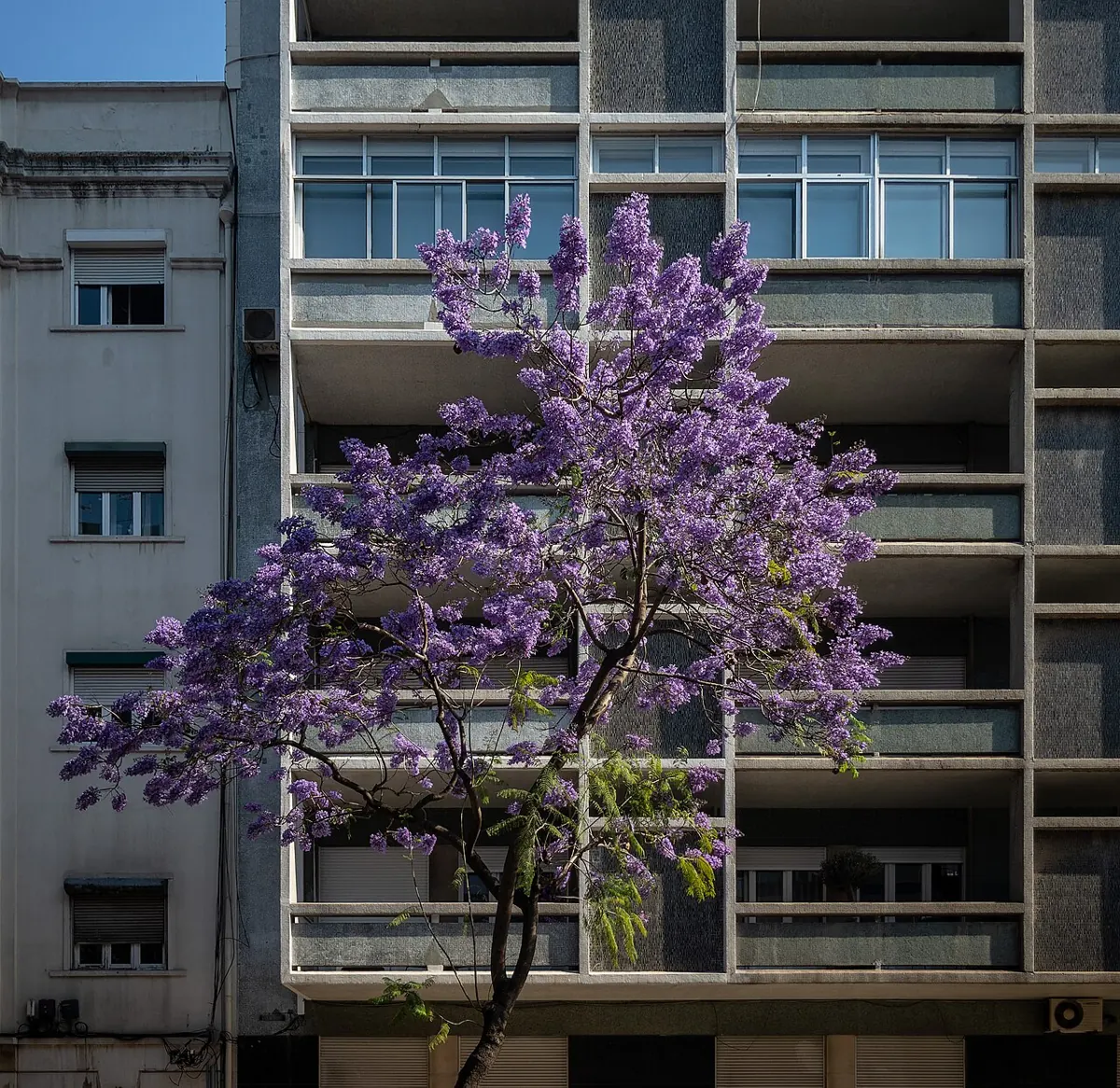
A crown covered in violet-blue flowers in late spring, and fine, fern-like leaves.
- LeafBroad and flat
- LeafLeaflets made of leaflets
- ShapeSpear-shaped
- ShapeOval
- EdgeSmooth
- On the twigIn pairs, facing each other
- In winterNo, it loses them
- BarkSmooth
- BarkFurrowed
- FruitCapsule that splits open
The leaf
A large leaf, divided twice into a great many tiny leaflets under 1 cm long, which give it a fern-like look. The leaves are opposite. It loses some of its leaves at the end of winter.
The bark
Greyish brown, smooth on young trees, with fine cracks and small scales on old ones.
The fruit
A woody, flat, almost round capsule about 5 cm across that splits into two halves like a pair of castanets. Inside are winged seeds.
The flower
Trumpet-shaped, violet-blue flowers in large clusters. It flowers in May and June, sometimes before the new leaves appear.
- Jan
- Feb
- Mar
- Apr
- May
- Jun
- Jul
- Aug
- Sep
- Oct
- Nov
- Dec
Habit
A medium-sized tree with a broad, open, somewhat irregular crown.
Where it grows
It is planted in streets and parks in coastal towns, where frosts are mild. It comes from southern Bolivia and northern Argentina.
What it can be mistaken for
The chinaberry has much larger, toothed leaflets, small lilac flowers and round fruit. The silver wattle has similar leaves, but silvery, alternate and evergreen, with yellow flowers in winter.
A story
Pretoria, in South Africa, is known as Jacaranda City for the thousands that bloom in its streets. Lisbon is famous for its jacarandas too.
Find out more
- Tree: Jules Verne Times Two, CC BY-SA 4.0
- Leaf: Crusier, CC BY 3.0
- Bark: Forest and Kim Starr, CC BY 3.0 us
- Fruit: Forest & Kim Starr, CC BY 3.0
- Flower: Svnavare, CC BY-SA 4.0