Trees · Moraceae
Fig
Ficus carica
Spanish HigueraCatalan FigueraIntroduced3–8 mDeciduous
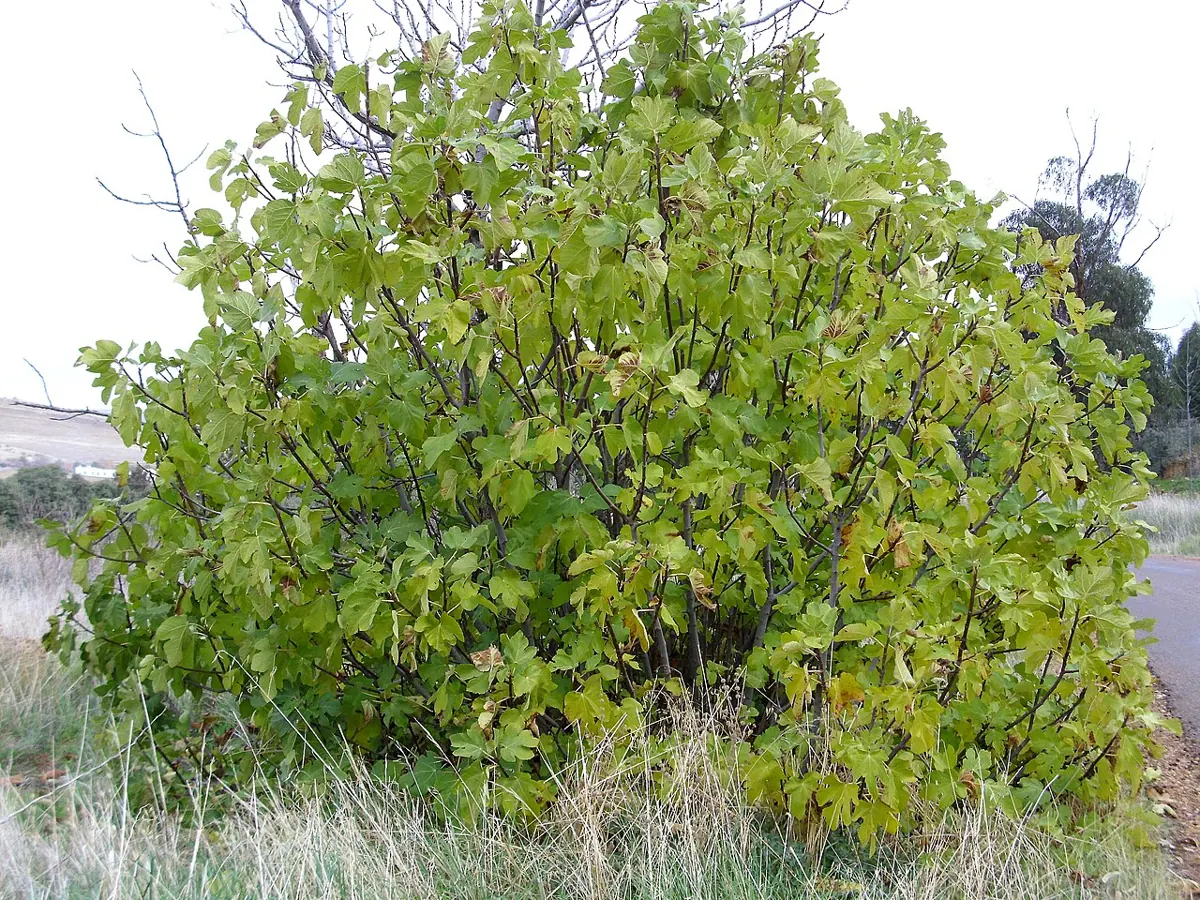
Big, rough leaves with three to five lobes like a hand, on a smooth grey trunk.
- LeafBroad and flat
- LeafYes, a single blade
- ShapeLobed
- ShapeLike a hand
- EdgeWavy or lobed
- On the twigOne at a time, staggered
- In winterNo, it loses them
- BarkSmooth
- FruitFleshy
The leaf
A large leaf, 10 to 25 cm, divided into three to five rounded lobes. It is thick and rough to the touch on top, and hairier underneath. Pull one off and a white latex oozes out.
The bark
Smooth and pale grey throughout the tree's life. The branches are grey too, and rather thick for the size of the tree.
The fruit
The fig is really a closed, fleshy pouch with the flowers inside. There are two crops: the early figs, called brevas, at the start of summer, and the main figs from August to October.
The flower
You can't see them: the flowers are inside the fig, which is like a closed urn with a tiny hole at the tip.
- Jan
- Feb
- Mar
- Apr
- May
- Jun
- Jul
- Aug
- Sep
- Oct
- Nov
- Dec
Habit
A low tree or large shrub, branching from near the ground, with a broad crown as tall as it is wide. It readily sends up shoots from the roots.
Where it grows
It has been grown all over Catalonia since ancient times, next to farmhouses and kitchen gardens. It runs wild on walls, banks, stream beds and rocky ground, and is common along the field edges of the Penedès.
What it can be mistaken for
The lobed leaf recalls the London plane, but the plane's leaf is thin and smooth with pointed teeth, and its bark peels in plates. The white mulberry sometimes has lobed leaves, but they are thinner and have toothed edges.


A story
Fig latex irritates the skin and, in sunlight, can leave marks and burns. In the countryside it was used to curdle milk for cheese, just like rennet.
Find out more
- Tree: Javier martin, Public domain
- Leaf: JLPC, CC BY-SA 3.0
- Bark: H. Zell, CC BY-SA 3.0
- Fruit: Antareszvezda, CC BY-SA 4.0