Trees · Sapindaceae
Field maple
Acer campestre
Spanish Arce campestreCatalan Auró blancNative5–15 mDeciduous
A hand-shaped leaf with five blunt lobes, and fruits with two wings in a straight line.
- LeafBroad and flat
- LeafYes, a single blade
- ShapeLike a hand
- EdgeWavy or lobed
- EdgeSmooth
- On the twigIn pairs, facing each other
- In winterNo, it loses them
- BarkFurrowed
- FruitWinged
The leaf
The leaf has three to five rounded lobes, with a smooth edge or the odd blunt tooth. It is small, five to ten centimetres, and grows in opposite pairs. If you snap the stalk, a little milky sap comes out.
The bark
The bark is grey-brown and cracks into thin, rectangular plates. Young twigs often have corky ridges.
The fruit
The samaras come in pairs, with the wings spread out in a straight line like a horizontal propeller. They are green, sometimes flushed pink, and turn brown in autumn.
The flower
It flowers in spring, once the leaves are out. The flowers are small and yellowish-green, in upright clusters.
- Jan
- Feb
- Mar
- Apr
- May
- Jun
- Jul
- Aug
- Sep
- Oct
- Nov
- Dec
Habit
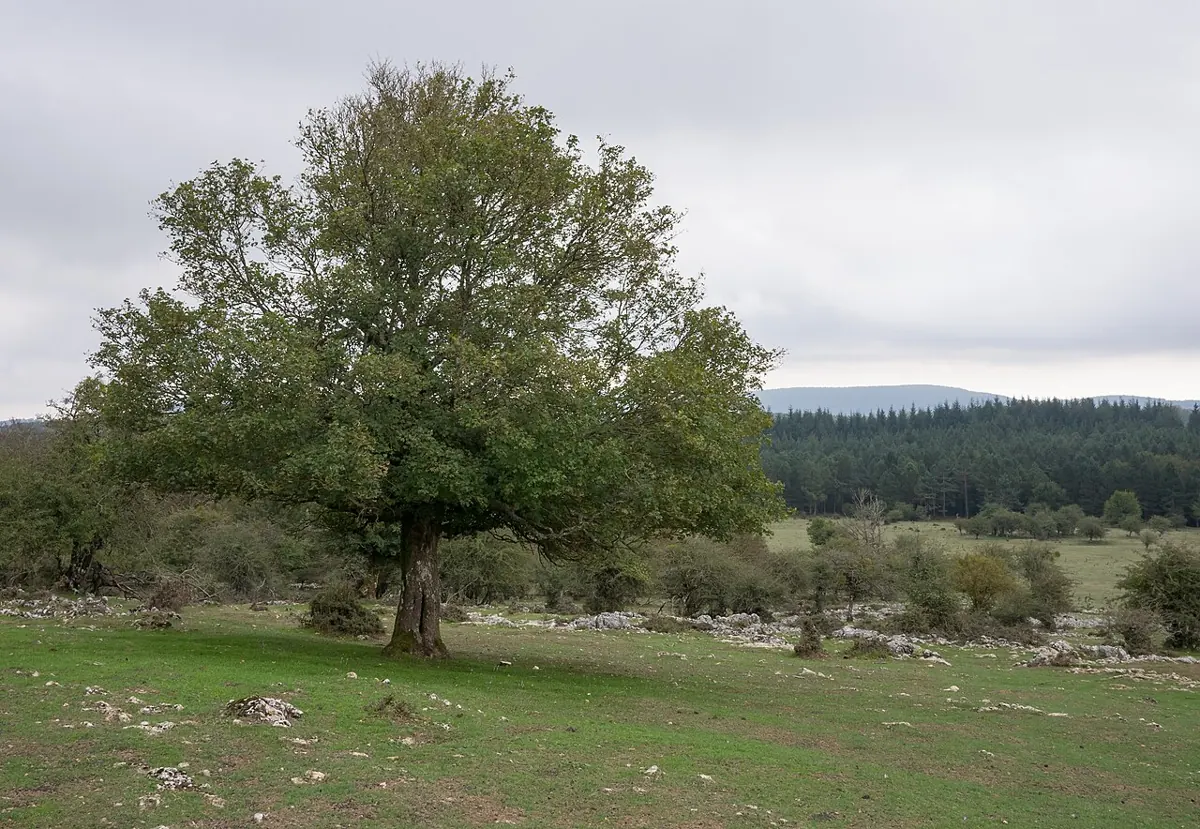
A small or medium-sized tree with a rounded, dense crown. It often appears as a shrub in hedges and field margins.
Where it grows
It grows in damp woods, hedges, field margins and along rivers, mainly in the northern half of Catalonia and in the lower mountains.
What it can be mistaken for
The Montpellier maple has a smaller, three-lobed leaf without milky sap, and its fruit wings are almost parallel. The London plane has much larger, alternate palmate leaves, and its bark peels off in plates. The white poplar sometimes has lobed leaves, but they are alternate and white underneath.


A story
In Italy it was used for centuries as a living support for vines: the vines climbed up maples planted in rows between the fields. This system was known as the 'married vine'.
Find out more
- Tree: Basotxerri, CC BY-SA 4.0
- Leaf: Willow, CC BY-SA 2.5
- Bark: Spiritia, CC BY 4.0
- Fruit: David Perez, CC BY 3.0