Trees · Cannabaceae
Nettle tree
Celtis australis
Spanish AlmezCatalan LledonerNative10–25 mDeciduous
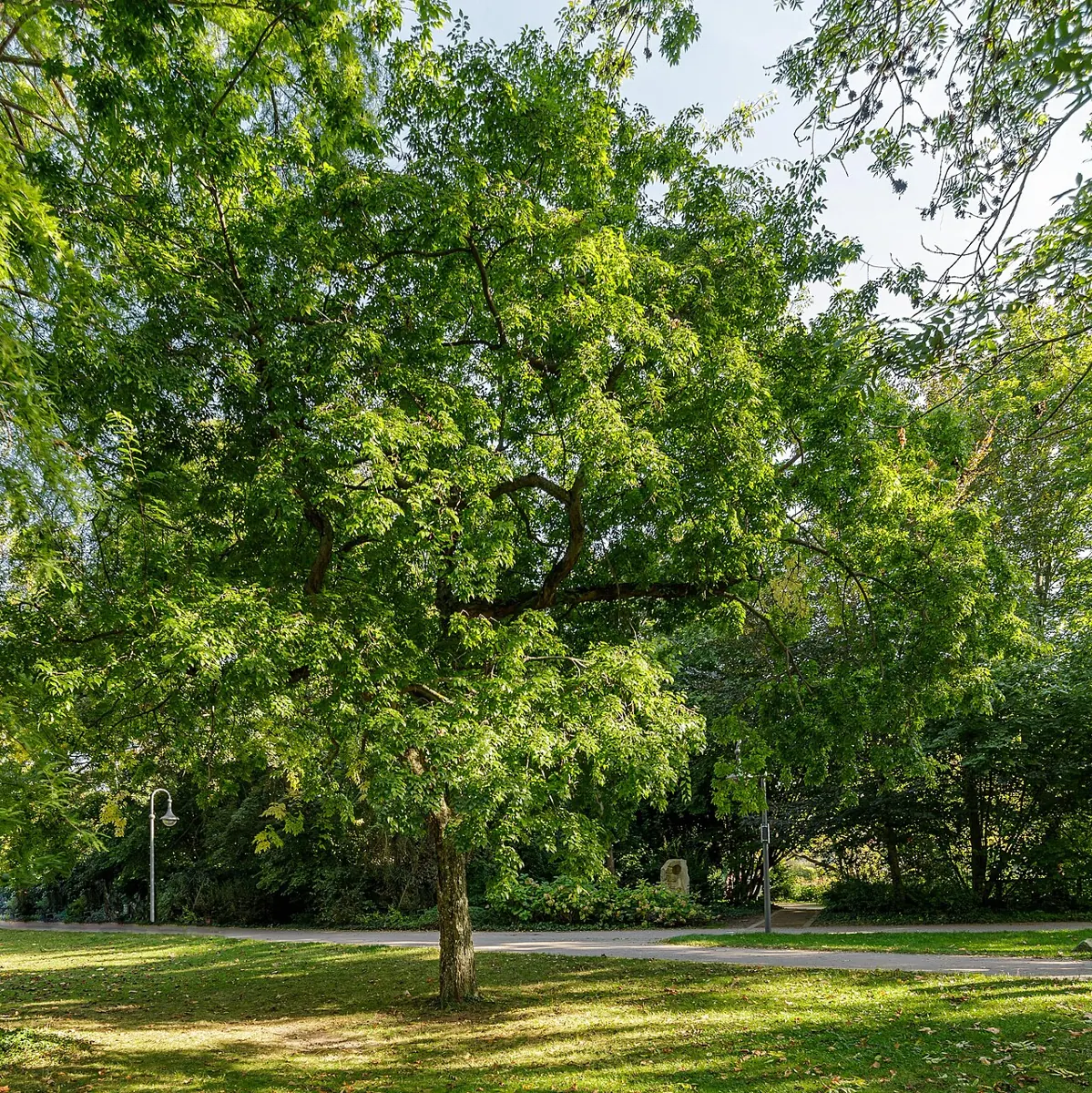
A smooth grey trunk like elephant skin, and toothed leaves ending in a long point.
- LeafBroad and flat
- LeafYes, a single blade
- ShapeSpear-shaped
- ShapeOval
- EdgeToothed
- On the twigOne at a time, staggered
- In winterNo, it loses them
- BarkSmooth
- FruitFleshy
The leaf
The leaf is lance-shaped, with a toothed edge and a very long tip, often slightly twisted. The base is asymmetric. It feels rough on top and is paler and softer underneath.
The bark
The bark is grey, smooth and thin, without cracks even on large trees. It is reminiscent of elephant skin, and of beech bark.
The fruit
It bears round, pea-sized fruits hanging from long stalks. They go from green to yellow and, when ripe in autumn, are black or purple. They have a thin layer of sweet, edible flesh around a hard stone.
The flower
The flowers are small, greenish and inconspicuous, and come out in spring with the new leaves.
- Jan
- Feb
- Mar
- Apr
- May
- Jun
- Jul
- Aug
- Sep
- Oct
- Nov
- Dec
Habit
A tree with a straight trunk and a broad, rounded, very leafy crown. It casts dense shade in summer.
Where it grows
It grows wild in ravines, along riverbanks and at the foot of cliffs in the lowlands of Catalonia. It is one of the most widely planted street trees in Barcelona and in many towns and cities.
What it can be mistaken for
The field elm has a shorter, broader leaf with double teeth, cracked bark and dry winged fruits. The white mulberry has broader leaves, sometimes lobed, and fruits that look like blackberries.
A story
Its wood is hard and very flexible. It was used for three-pronged hay forks, whip handles and walking sticks, and in some places nettle trees were grown specially to make them.
Find out more
- Tree: Friedrich Haag, CC BY-SA 4.0
- Leaf: Júlio Reis, CC BY-SA 3.0
- Bark: Consultaplantas, CC BY-SA 4.0
- Fruit: Eiku, CC BY 4.0