Trees · Pinaceae
Silver fir
Abies alba
Spanish AbetoCatalan AvetNative25–45 mEvergreen
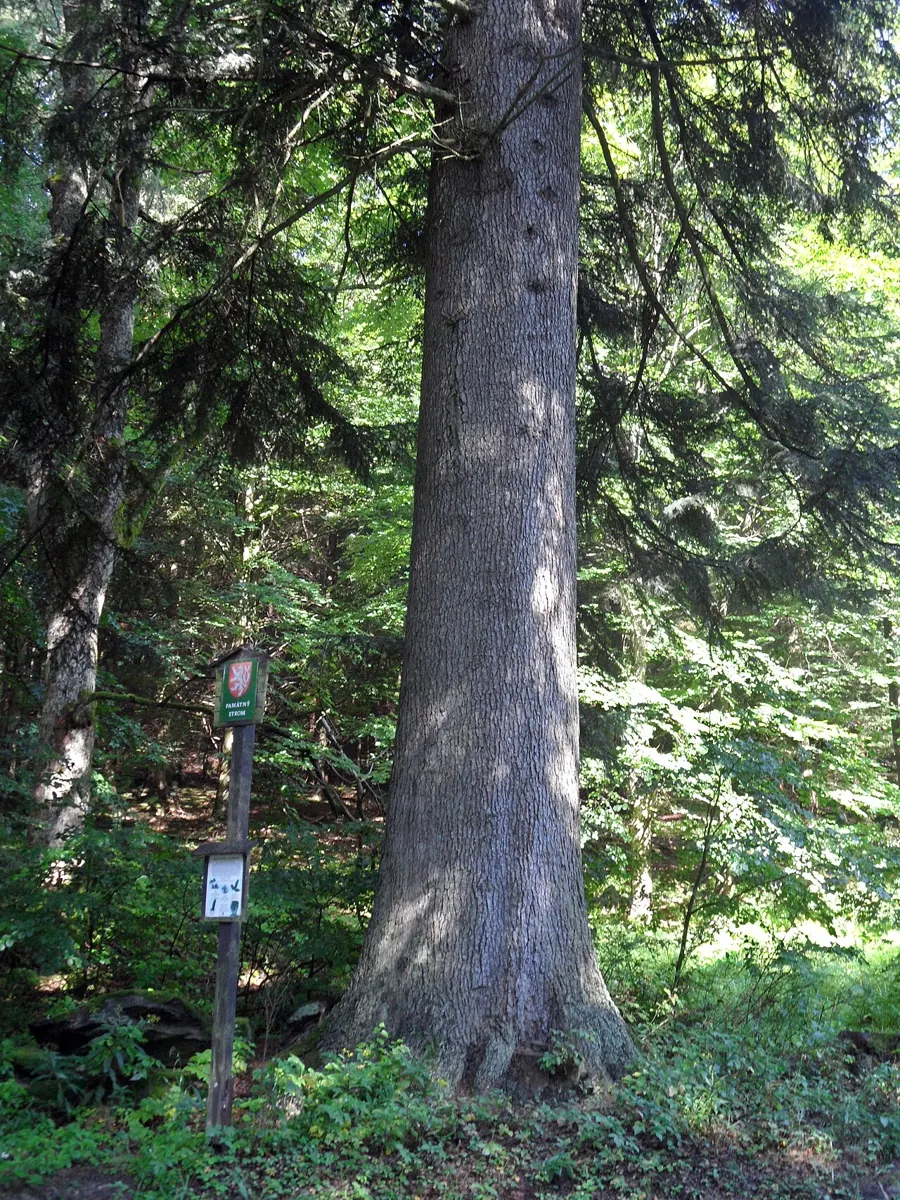
A tall, conical mountain conifer with flat, single needles set in two rows like a comb.
- LeafNeedles
- NeedlesOne by one
- In winterYes, always green
- BarkSmooth
- BarkFurrowed
- FruitCone
The leaf
Single needles, flat and soft, 2 to 3 cm, with a blunt or notched tip. They are glossy dark green above with two white stripes beneath, and are arranged on both sides of the twig, like a comb.
The bark
Smooth and pale grey, almost whitish, for many years. On old trees it cracks into small plates.
The fruit
Cylindrical cones 10 to 20 cm long that stand upright on the top branches. They fall apart on the tree when ripe, so you almost never find a whole one on the ground.
The flower
The male flowers are small and yellow, under the branches; the female ones are greenish and upright, at the very top of the crown. They are rarely noticed.
- Jan
- Feb
- Mar
- Apr
- May
- Jun
- Jul
- Aug
- Sep
- Oct
- Nov
- Dec
Habit
A tall tree, 25 to 45 m, with a straight trunk and a very regular conical crown, its branches in tiers. Old trees have a flattened top, like a stork's nest.
Where it grows
It grows in the Pyrenees and Pre-Pyrenees on cool, shady slopes, roughly between 1,000 and 1,900 m, often with beech or Scots pine. A small isolated population survives in the Montseny, the southernmost in Catalonia.
What it can be mistaken for
The yew also has flat needles in two rows, but without white stripes, and a fleshy red fruit. Pines such as the mountain pine or the Scots pine carry their needles in pairs. Needles with two white stripes beneath and upright cones belong to the silver fir.
A story
It is one of Europe's classic Christmas trees. Its white, light wood has been used for joinery, and in the Pyrenees it too was floated down the rivers on the raftsmen's log rafts.
Find out more
- Tree: Stribrohorak, CC BY-SA 4.0
- Leaf: Moinats, CC BY-SA 4.0
- Bark: Crusier, CC BY-SA 3.0
- Fruit: Gmihail, CC BY-SA 3.0 rs