Trees · Fagaceae
Downy oak
Quercus pubescens
Spanish Roble pubescenteCatalan Roure martinencNative10–20 mDeciduous
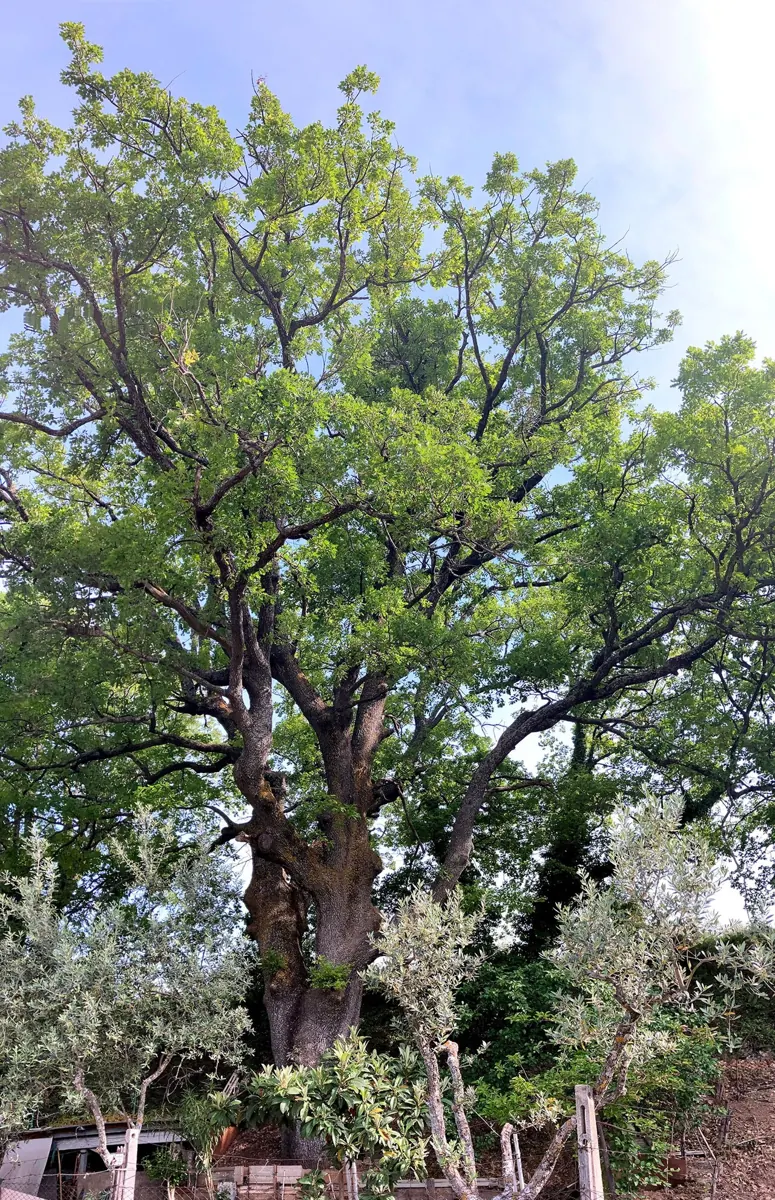
An oak with lobed leaves, downy beneath, that keeps its dead leaves through winter.
- LeafBroad and flat
- LeafYes, a single blade
- ShapeLobed
- EdgeWavy or lobed
- On the twigOne at a time, staggered
- In winterNo, it loses them
- BarkFurrowed
- FruitAcorn
The leaf
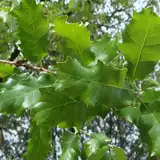
Leaves 5 to 10 cm long, with shallow rounded lobes and a short stalk. Underneath, like the young twigs, they are covered in soft hairs you can feel with your fingers.
The bark
Dark grey, thick and broken into plates by deep, fairly regular fissures.
The fruit
Acorns 1.5 to 3 cm long, with no stalk or a very short one, in a cup of grey, hairy scales.
The flower
Hanging greenish-yellow catkins that appear at the same time as the new leaves, in spring.
- Jan
- Feb
- Mar
- Apr
- May
- Jun
- Jul
- Aug
- Sep
- Oct
- Nov
- Dec
Habit
A tree 10 to 20 m tall, often with a crooked trunk and a broad, irregular crown. In winter it keeps many dry brown leaves until the new ones come out.
Where it grows
It is the most common oak in inland Catalonia, in the middle mountains and in areas a little cooler than holm oak country, roughly from 400 to 1,200 m, almost always on limestone.
What it can be mistaken for
The sessile oak has leaves that are smooth beneath, on a long stalk. The Portuguese oak has toothed leaves, not lobed ones. The hairs on the underside of the leaves and on the twigs are the mark of the downy oak.

A story
Black truffles grow beneath downy oaks and holm oaks, which is why they are planted in truffle orchards. Keeping dead leaves through the winter is called marcescence, and in Catalonia it helps you spot this oak from a distance.
Find out more
- Tree: Jynjyn, CC BY-SA 4.0
- Leaf: Kenraiz, Public domain
- Bark: Awinch1001, CC0
- Fruit: Dimìtar Nàydenov, CC BY-SA 4.0