Trees · Fagaceae
Beech
Fagus sylvatica
Spanish HayaCatalan FaigNative25–40 mDeciduous
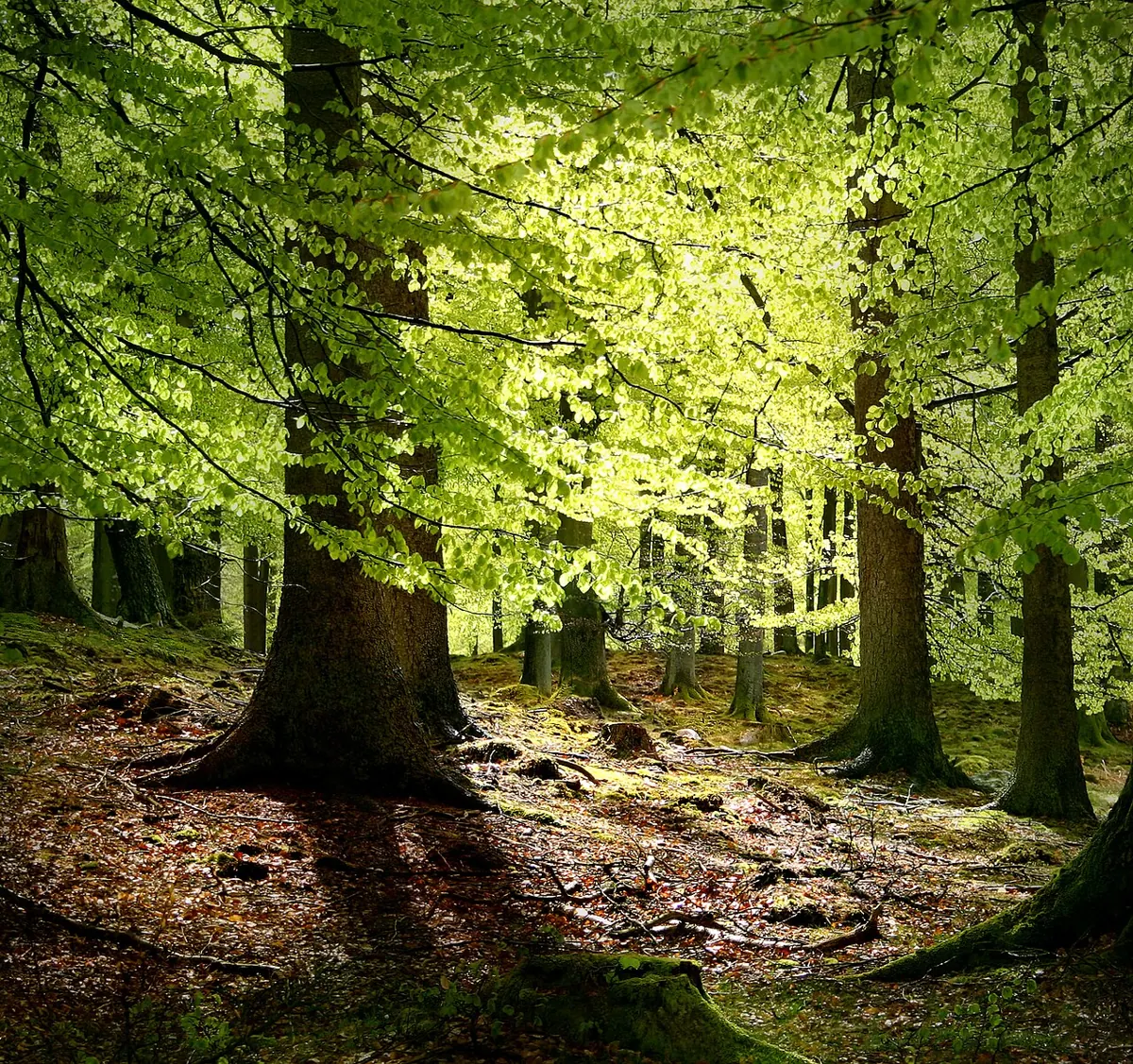
A smooth grey trunk like concrete, and oval leaves with wavy edges.
- LeafBroad and flat
- LeafYes, a single blade
- ShapeOval
- EdgeSmooth
- On the twigOne at a time, staggered
- In winterNo, it loses them
- BarkSmooth
- FruitNut
The leaf
The leaf is oval and glossy, with a smooth, slightly wavy edge. Young leaves have fine hairs along the edge that show up against the light. The side veins are straight and parallel.
The bark
The bark is silver-grey, thin and completely smooth, even on very old trees. It is often patched with lichens.
The fruit
The fruits, beechnuts, are small, shiny brown triangular nuts. They come in pairs inside a woody husk covered in soft spines, which splits into four parts in autumn.
The flower
It flowers in spring, as the leaves come out. The male flowers hang in hairy little balls and the female ones are small and upright; neither is showy.
- Jan
- Feb
- Mar
- Apr
- May
- Jun
- Jul
- Aug
- Sep
- Oct
- Nov
- Dec
Habit
A large tree with a straight trunk and a broad crown that casts very deep shade. Almost nothing grows beneath a beech wood. Young trees keep their dry brown leaves through the winter.
Where it grows
It needs moisture and mist. In Catalonia it forms woods in the Pyrenees, the Montseny, the Garrotxa and the Ports de Beseit. It does not grow in the Penedès.
What it can be mistaken for
The wild cherry has toothed leaves and reddish bark with horizontal bands. The sweet chestnut also has its fruit inside a spiny husk, but a much pricklier one, with large chestnuts, and its leaves are long and toothed.
A story
La Fageda d'en Jordà, in the Garrotxa, is a beech wood growing on the lava flow of a volcano. The poet Joan Maragall wrote a much-loved poem about it.
Find out more
- Tree: Malene Thyssen, CC BY-SA 3.0
- Leaf: T. Kebert, CC BY-SA 4.0
- Bark: Krzysztof Golik, CC BY-SA 4.0
- Fruit: Dominicus Johannes Bergsma, CC BY-SA 4.0