Trees · Pinaceae
Atlas cedar
Cedrus atlantica
Spanish Cedro del AtlasCatalan Cedre de l'AtlesIntroduced20–35 mEvergreen
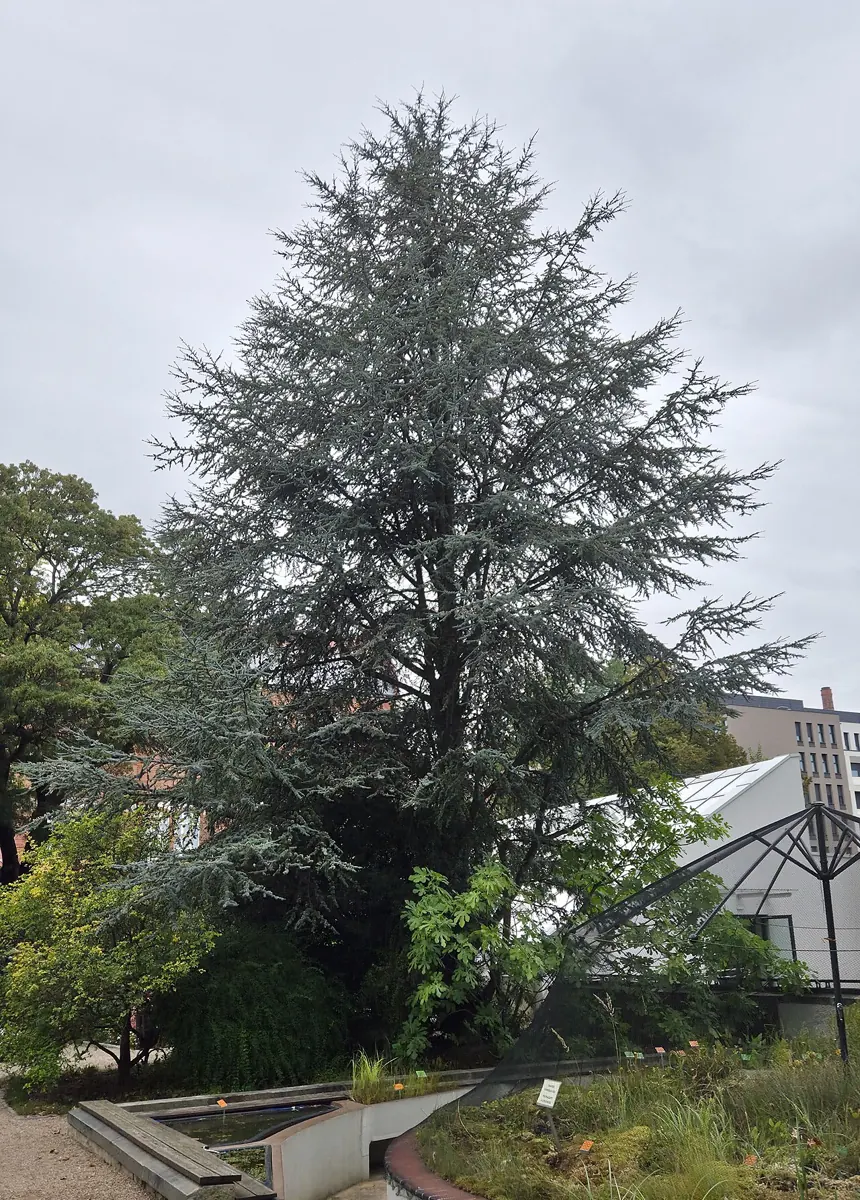
A park conifer with short needles in rosettes, often bluish, and cones like upright barrels.
- LeafNeedles
- NeedlesIn dense tufts
- In winterYes, always green
- BarkFurrowed
- BarkFlaking in plates
- FruitCone
The leaf
Short, stiff needles, 1 to 3 cm, growing in rosettes of many together on very short spur shoots. They are green or, in the most widely planted form, a silvery blue.
The bark
Dark grey and smooth when young; with age it cracks into small, scaly plates.
The fruit
Barrel-shaped cones, 5 to 8 cm, standing upright on the branches. They take two years to ripen and break up on the tree, shedding scales and winged seeds.
The flower
It flowers in autumn, which is unusual among trees. The male flowers are long, upright cones that release a lot of yellow pollen; the female ones are small and greenish.
- Jan
- Feb
- Mar
- Apr
- May
- Jun
- Jul
- Aug
- Sep
- Oct
- Nov
- Dec
Habit
A tree 20 to 35 m tall, conical with a drooping leader when young, later broad with flat, horizontal tiers.
Where it grows
It comes from the Atlas Mountains of Morocco and Algeria. In Catalonia it is planted in parks, gardens, cemeteries and beside farmhouses, and occasionally in mountain reforestation.
What it can be mistaken for
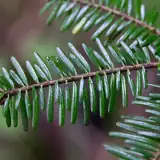
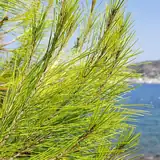
The silver fir has single, flat needles, not rosettes. Pines such as the Aleppo pine carry their needles in pairs and much longer. Rosettes of short needles are the mark of the cedar.
A story
In its homeland it is endangered by drought and felling. Its wood is fragrant and resists rot, and cedarwood oil is used in perfumery.
Find out more
- Tree: Crusier, CC BY 4.0
- Leaf: Derek Ramsey, CC BY-SA 2.5
- Bark: Frank Vincentz, CC BY-SA 3.0
- Fruit: Liné1, CC BY 2.5